
French terry and 2-thread fleece
Smooth face, looped back. For light hoodies, sweatshirts and joggers in spring and autumn. Brushed versions have a soft, fluffy inside.


French terry (2-thread) is lighter than 3-thread fleece and heavier than a t-shirt. At 210–250 g/m² it makes seasonal sweatshirts and joggers; at 280 g/m², brushed, it becomes a warm hoodie.
Elastane versions recover better at elbows and knees and suit co-ord sets and fitted trousers.
- Hoodies and sweatshirts
- Joggers
- Two-piece sets
- Kidswear
- Sporty dresses
- Spring–autumn collections
Articles in the 2026 offer
| Ref. | Article | Code | Yarn | Finish | Form |
|---|---|---|---|---|---|
| AT-016 | 2-thread brushed fleece, optic white / grey melange | 201CA · 201GC | 20/10 OE | Enzyme + silicone + brushed | Tubular |
| AT-017 | 2-thread brushed fleece, dyed | 201CC | 20/10 OE | Enzyme + silicone + brushed | Tubular |
| AT-018 | Izmana brushed fleece, grey melange | 301GC | 30/10 OE | Enzyme + silicone + brushed | Tubular |
| AT-019 | Izmana brushed fleece, optic white | 241CA | 24/10 OE | Enzyme + silicone + brushed | Tubular |
| AT-020 | Izmana brushed fleece, dyed | 241CC | 24/10 OE | Enzyme + silicone + brushed | Tubular |
| AT-031 | Combed french terry — white / grey melange / dyed | 303COLA · 303COLG · 303COLC | 30/30 combed | Enzyme + silicone | Open width |
Range from the 2026 offer. Colours are dyed to the code you pick from the card: minimum 150 kg per article per colour. Stock items are sold with no minimum.
Questions about french terry
What is french terry and what does it look like?
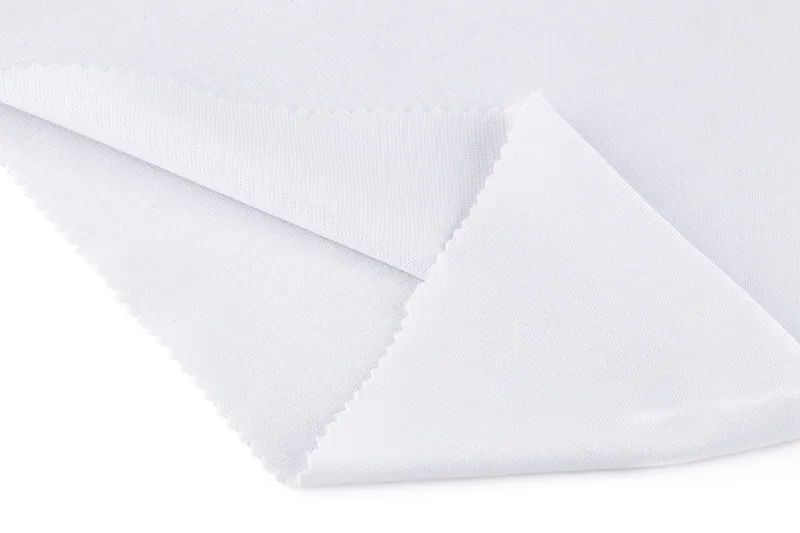
French terry is a knit with a smooth face, like jersey, and a back with small, unbrushed loops formed by an additional yarn. It is knitted on a single needle bed with a ground yarn and a loop yarn. The looped back is soft, breathable and absorbs moisture.
It is the classic fabric for lightweight hoodies, joggers and mid-season clothing. Because it is not brushed, it is lighter and less warm than fleece. You can recognise it easily by the visible loops on the back.
Open answerFrench terry or fleece: how do you tell them apart?
The face looks the same, smooth, but the back differs. French terry has small visible loops on the back because it has not been brushed. In fleece the loop has been brushed, so the back is fluffy with no visible loops, thicker and warmer. The same looped knit can become fleece after brushing.
For a summer or spring hoodie, french terry is enough and more breathable. For winter or warm layers, fleece is more suitable. Ask to see the back of the fabric before ordering rather than relying on the name.
Open answerWhat is izmana?
Izmana is a term used in the Turkish textile industry and in the Romanian trade for a knit in the french terry family, with a smooth face and a looped back. The exact meaning varies between mills: some use it for a heavier fabric, others for a slightly textured or brushed variant. So the name alone does not guarantee what you receive.
When ordering, describe the structure (2-thread or 3-thread, looped or brushed), the weight and the composition, and ask for a swatch. If you already have a garment, send a sample so the fabric can be identified correctly.
Open answerWhich yarn count is used for sweatshirts and heavy knits?
For medium and heavy sweatshirts and french terry, thicker yarns are used than for T-shirts: usually Ne 16/1 to 30/1 for the outer face, and for the brushed or looped inside a thicker yarn, for example Ne 10/1 to 16/1. The exact figure depends on weight and machine gauge.
Thicker yarn gives a more voluminous, warmer and cheaper fabric but with a rougher surface. For better quality, carded or combed ring yarn at finer counts gives a softer sweatshirt. Ask for the yarn count together with the weight.
Open answerHow many hoodies can I make from a 25 kg roll?
An adult hoodie with a hood, pocket and long sleeves usually uses 0.6 to 0.9 kg of fabric, plus 0.05 to 0.1 kg of rib for cuffs and hem. So a 25 kg roll makes about 28 to 38 hoodies, depending on GSM and cut.
A 280 GSM french terry hoodie is around 0.65 to 0.75 kg, while an oversized 380 GSM one can pass 1 kg. If you produce several sizes, consumption rises by about 5 to 8% per step from S to XL. The exact figure comes from the marker with your cutter's real efficiency, not from averages.
Open answerWhat is the difference between macro and micro silicone softeners?
A macro silicone softener has large particles, forms a film on the fibre surface and gives a full, slippery, almost oily hand, but it can leave stains and reduce absorbency. A micro (or nano) silicone penetrates better between the fibres, gives a soft, dry and even hand, and affects hydrophilicity less. For cotton tees that need good absorbency, micro silicone is usually chosen; macro is used where bulk and strong softness are wanted, such as sweatshirts. Ask the supplier which type is used, not just for a soft hand.
Open answerArticles where we recommend this fabric
 Starting a clothing brand
How to define the ideal customer for your clothing brand
A customer profile is not a marketing exercise filed in a drawer. It is the tool you use to choose fabric, price, sizing and the words you put on your site.
 Garment manufacturing
How to run a fit session and write fit comments for knitwear
A well-run fit session cuts weeks off development. A rushed one produces vague comments, remade samples and an unhappy client.
 Hoodies & sweatshirts
DTF transfers on hoodies: how to press them properly
DTF is fast and has no set-up cost, but a hoodie is a harder surface than a T-shirt. Preparation, the press and the fabric make the difference.
 Polo shirts & uniforms
Corporate sweatshirts as a uniform layer for offices and shops
In offices and shops the problem is not frost but air conditioning and chilly mornings. A light branded sweatshirt keeps the team consistent when a polo is not enough.
 Loungewear, pyjamas & activewear
How to start an athleisure brand in Romania, step by step
Athleisure looks crowded, but it is full of customers who cannot find exactly what they want. A small brand wins through clarity, not through the number of styles.
 Quality, compliance & sustainability
How to raise a fabric quality claim with your supplier properly
Serious suppliers resolve quality problems, but they need data, not impressions. A well-built claim saves time on both sides.
220 colours. Pick them right on the product page.
Any fabric in the range can be dyed in any of the 220 colours — or matched to your sample (lab dip). From 150 kg per colour.