
Single jersey fabric for t-shirts
The plain knit used for t-shirts, tank tops, pyjamas and underwear. Smooth on the face, small loops on the back.

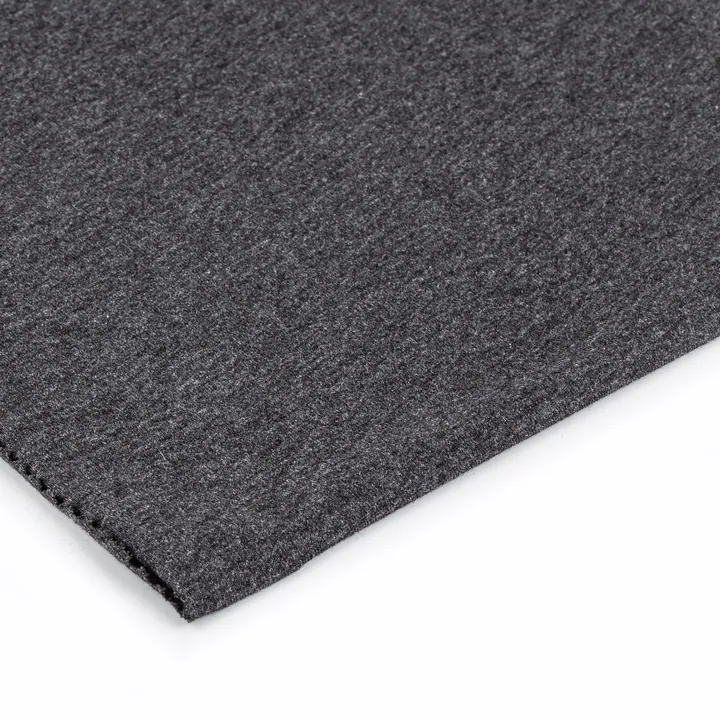


Single jersey is the most used knit in garment making. Weight tells you how substantial it is: 140–160 g/m² for promotional tees and underwear, 170–190 g/m² for quality tees, over 200 g/m² for oversized and heavyweight tees.
We carry it in 100% combed cotton, with elastane for fitted styles and blended with polyester for stability and price. Made to order we also produce plated, slub, modal and viscose jerseys.
- T-shirts and promotional tees
- DTF, screen print and embroidery
- Pyjamas and underwear
- Dresses, tops and bodysuits
- Oversized heavyweight tees
- Hood linings
Articles in the 2026 offer
| Ref. | Article | Code | Yarn | Finish | Form |
|---|---|---|---|---|---|
| AT-001 | Single jersey, optic white | 30SJA | 30/1 OE | Enzyme + silicone | Tubular |
| AT-002 | Single jersey, grey melange | 30GSJ | 30/1 OE | Enzyme + silicone | Tubular |
| AT-003 | Single jersey, dyed | 30SJC | 30/1 OE | Enzyme + silicone | Tubular |
| AT-004 | Single jersey, printed on white | 30SJIA | 30/1 OE | Enzyme + silicone + print | Tubular |
| AT-005 | Single jersey, printed on colour | 30SJIC | 30/1 OE | Enzyme + silicone + print | Tubular |
| AT-012 | Lycra jersey, optic white / grey melange | 30LSJA · 30GLSJ | 30/1 OE | Enzyme + silicone | Tubular |
| AT-013 | Lycra jersey, dyed | 30LSJC | 30/1 OE | Enzyme + silicone | Tubular |
| AT-022 | Single jersey white, 2nd quality (while stock lasts) | 30SJAABRAJ | 30/1 OE | Enzyme + silicone | Tubular |
| AT-027 | Combed jersey, optic white / grey melange | 30COSJA · 30COGSJ | 30/1 combed | Enzyme + silicone | Tubular |
| AT-028 | Combed jersey, dyed | 30COSJC | 30/1 combed | Enzyme + silicone | Tubular |
| AT-036 | Combed full-lycra jersey — white / grey / dyed | 30COLSJA · 30COLGSJ · 30COLSJC | 30/1 combed | Enzyme + silicone | Open width |
| AT-037 | Combed full-lycra jersey 40/1 — white / grey / dyed | 40COLSJA · 40COGLSJ · 40COLSJC | 40/1 combed | Enzyme + silicone | Open width |
Range from the 2026 offer. Colours are dyed to the code you pick from the card: minimum 150 kg per article per colour. Stock items are sold with no minimum.
Questions about jersey
What is single jersey (glat, suprem) knit fabric?
Single jersey is the simplest circular knit: one set of needles forms a fabric with V-shaped knit stitches on the face and rounded purl-looking loops on the back, which looks flatter and duller. It is light and soft, stretches more across the width than along the length, and curls at cut edges.
It is the base structure for t-shirts, tops and summer garments. It cuts and sews quickly, and the smooth face prints well. It does not have the dimensional stability of interlock.
Open answerWhat is pointelle knit?
Pointelle is a knit with small, regular openings formed by moving stitches from one needle to another, creating a decorative pattern, usually floral or geometric. It is an openwork knit, thin and airy, with a delicate look. It is made on machines with double beds or with a transfer mechanism.
It is used for women's tops, children's and baby clothes and summer tops. Because it is delicate, the openings can enlarge when pulled or snagged, so test stability on a swatch and sew without forcing the stretch.
Open answerWhat is knitted mesh (eyelet)?
Knitted mesh is a fabric with small, regular openings formed by the stitch structure rather than perforation. Eyelet is the variant with larger, visible, eye-shaped holes. The openings promote air circulation and moisture release, which is why they are used in sportswear and in areas that must breathe.
Mesh is light, airy and dries quickly, but it is more delicate than a compact jersey. On a swatch check opacity, snagging and distortion after stretching. It suits sports t-shirts, linings and ventilation panels.
Open answerWhat is circular machine diameter and how does it affect tubular width?
The diameter of a circular knitting machine, expressed in inches, determines the width of the fabric tube. The larger the diameter, the more needles and the wider the tube. As it leaves the machine, the tube is flat or slit open, and the usable width also depends on the needle count and on finishing.
In practice the final width after dyeing and finishing is smaller or larger than on the machine, depending on the knit. When ordering, ask for the finished tubular or open width, not the machine diameter. The usable cutting width is what matters for your consumption.
Open answerWhat is the difference between a sweater knit and a cut-and-sew jersey garment?
A knitted sweater is produced directly on flat machines in the shape of the piece, with no cutting or minimal cutting, with lengths and shapes controlled during knitting. A cut-and-sew garment is made from circular knitted fabric, cut into pieces and sewn. The first method gives pieces with coarser stitches and more pattern options, the second is faster and cheaper for large runs.
Alteks Tricot supplies fabric for cut-and-sew garments, sold by the kilogram. For fully fashioned pieces, look for a knitwear manufacturer.
Open answerWhat is the difference between weft knit and warp knit?
In weft knit, one yarn forms stitches row by row across the width of the fabric, as in jersey, interlock or french terry. It is stretchy and soft but can unravel if a stitch breaks. In warp knit, each needle has its own yarn running along the length of the fabric, as in tricot or raschel.
Warp knit is more stable, does not unravel easily and is used for lingerie, nets and technical fabrics. Everyday garment fabrics, such as those from Alteks, are circular weft knits.
Open answerArticles where we recommend this fabric
 Starting a clothing brand
How to start a clothing brand in Romania: the essential steps
From an idea on paper to your first pieces sold: the right order of decisions, what each stage involves and where new founders most often go wrong.
 Garment manufacturing
CMT, FOB or full package: which model should your workshop offer?
Your commercial model decides who buys the fabric, who carries the risk and how much capital one order ties up. The wrong choice can sink an otherwise good workshop.
T-shirtsDTG printing on t-shirts: which fabric and what pretreatment
A DTG printer puts ink straight into the fibre, so the result depends almost entirely on how much cotton the tee contains and how well it was pretreated.
 Kidswear & babywear
Fabric consumption for small sizes: how much per baby garment
On small garments, a few points of marker efficiency change the cost per piece more than a discount on the fabric price. Here is the calculation step by step.
 Loungewear, pyjamas & activewear
Sizing fitted activewear: negative ease and grading explained
In fitted activewear, the pattern is smaller than the body. How much smaller depends on the fabric, and a few centimetres of error turn into returns.
 Quality, compliance & sustainability
How to write a measurement chart with tolerances for production
Without a measurement chart and tolerances, 'the tee is too short' is just an opinion. With one, it is a measurement anyone can check.
220 colours. Pick them right on the product page.
Any fabric in the range can be dyed in any of the 220 colours — or matched to your sample (lab dip). From 150 kg per colour.