

Fitted activewear rarely fails because of colour or stitching. It fails because after a few wears the knees of the leggings bag out, the hem of the top flares or the edges stop holding. These are all stretch and recovery problems, and you can catch them before a bulk order with a test carried out in your own workroom.
Stretch and recovery are not the same thing
Stretch tells you how far a fabric extends under a given force. Recovery tells you how close it returns to its original length once the force is removed. A knit can stretch a long way and still recover badly, which is the classic behaviour of fabrics with no elastane, or with too little elastane for their weight.
For activewear you need both values in both directions: lengthwise, along the wales, and widthwise, along the courses. Most knits stretch more across the width, and your pattern has to be planned around that.
The workroom test, step by step
You do not need a laboratory for a first assessment. You need a ruler, a fabric marker, a timer and a known weight, such as a 1 kg bottle of water.
- Cut a strip 5 cm wide and about 30 cm long in the direction you want to test. Let the fabric relax on the table for a few hours after it comes off the roll.
- Mark two lines exactly 20 cm apart.
- Clamp one end and hang the weight from the other end without jerking it.
- After one minute, measure between the marks. The increase over 20 cm, divided by 20 and multiplied by 100, gives stretch as a percentage.
- Remove the weight, let the strip relax flat for 30 minutes and measure again. Whatever remains above 20 cm is permanent growth.
For example, if the marks are 30 cm apart under load, stretch is 50%. If they measure 20.6 cm after relaxing, permanent growth is 3% and recovery is 97%.
What values are reasonable
There are no universal pass marks, but a few practical reference points help:
- for fitted tops and sports tees, permanent growth under 5% after relaxation is generally acceptable;
- for leggings and anything that stays stretched on the body for hours, aim as low as possible, ideally under 3%;
- for bands, cuffs and edges that must hold their shape, recovery matters more than maximum stretch.
Repeat the test three times in each direction and work with the average. One strip on its own can mislead you.
The fatigue test: what happens after an hour of wear
The first test shows behaviour under a single stretch. In real life the fabric is stretched and released hundreds of times in one workout. For a simple simulation, stretch the strip by hand to roughly 80% of its measured stretch, fifty times in a row, then let it relax and measure. Do the same after five washes. If growth rises sharply after washing, the finish or the elastane content is not right for the product.
For large runs, or for customers who ask for reports, commission laboratory tests using the standard methods for elastic knits. The workroom test does not replace them, but it lets you discard unsuitable samples quickly and cheaply.
Example: rib for sports tops
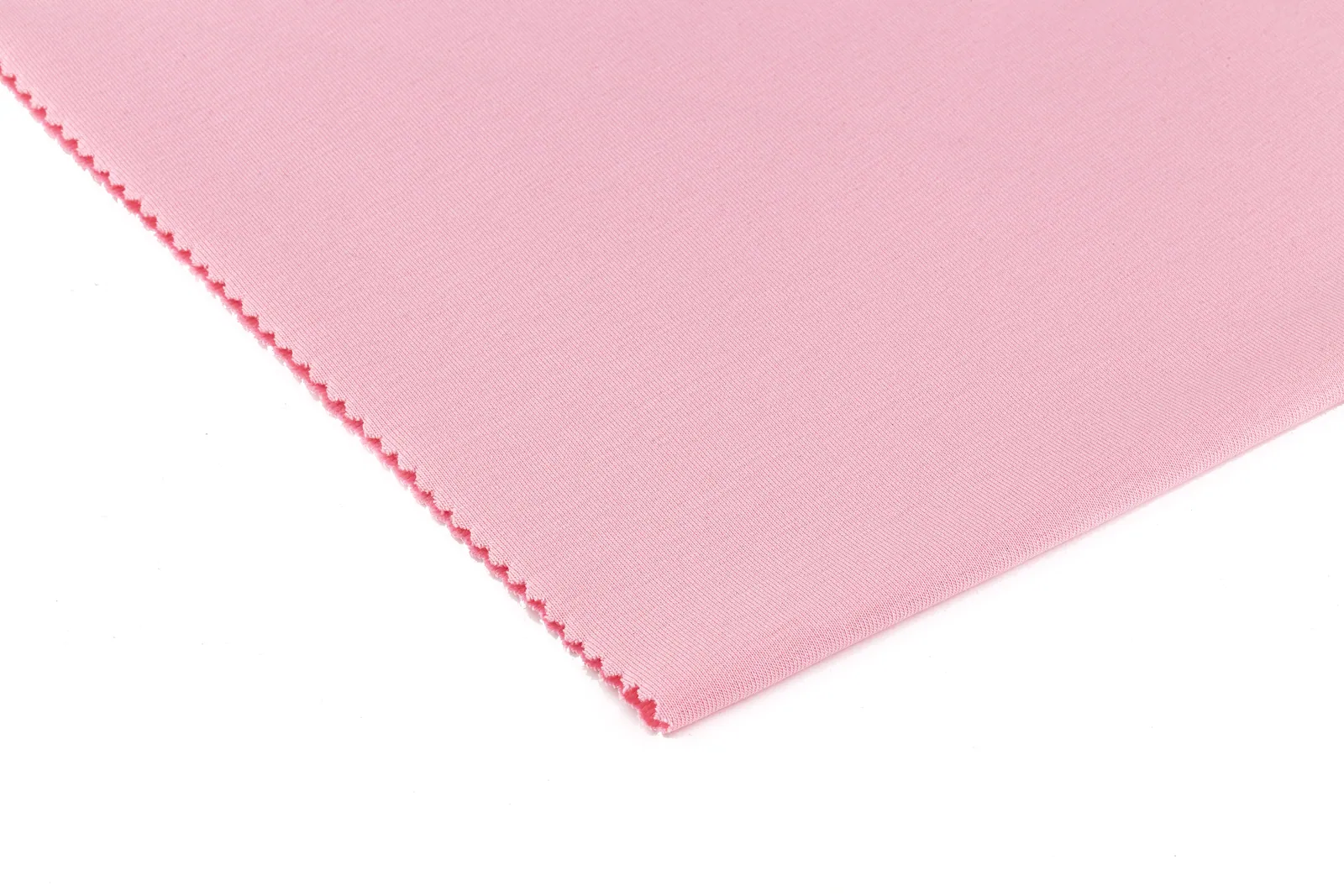
Rib is a structure that naturally stretches a lot across the width and, with elastane, recovers very well. An optic white 220 gsm combed cotton-elastane rib is a good fabric to test for bralettes, crop tops and gym vests: it has enough body not to go see-through and recovers fully after stretching, so edges do not flare. Optic white is also a sensible base for prints or for dyeing to order. You can compare results with other structures in the rib and cascorse family.
From test to order
Once the sample gives acceptable results, record the measured values and the method in your tech pack so you can check every lot on arrival. For small runs, the rib is available from stock in Afumați and is sold by the roll with no minimum. If you want a different colour, the article can be made to order in any of the 220 card colours from 150 kg per colour. For per-kg prices, send a quote request.
Frequently asked questions
Which direction should I test first?
Start with the direction the fabric will be stretched most on the body, usually the width, which runs around the body on leggings and tops. Then test the length too, because poor lengthwise recovery causes distorted hems and baggy knees.
Does water temperature matter in the post-wash test?
Yes. Use the temperature you will print on the care label, not a gentler one. If the fabric only recovers well at 30 degrees but customers wash at 40, you will only discover the problem through returns and complaints.
Can pattern cutting improve recovery?
Partly. You can reduce the pattern slightly in high-stretch areas or add rib bands at the edges. But cutting cannot rescue a fabric with poor recovery; if permanent growth is high, change the article or its elastane content.


