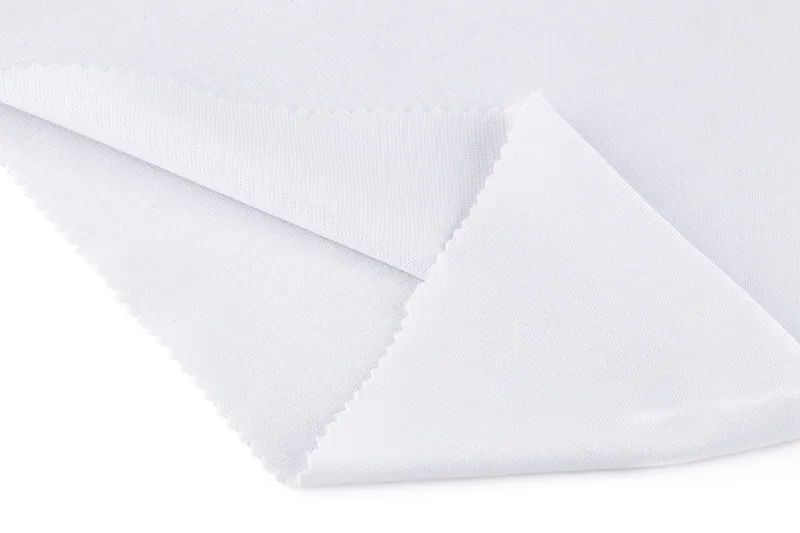

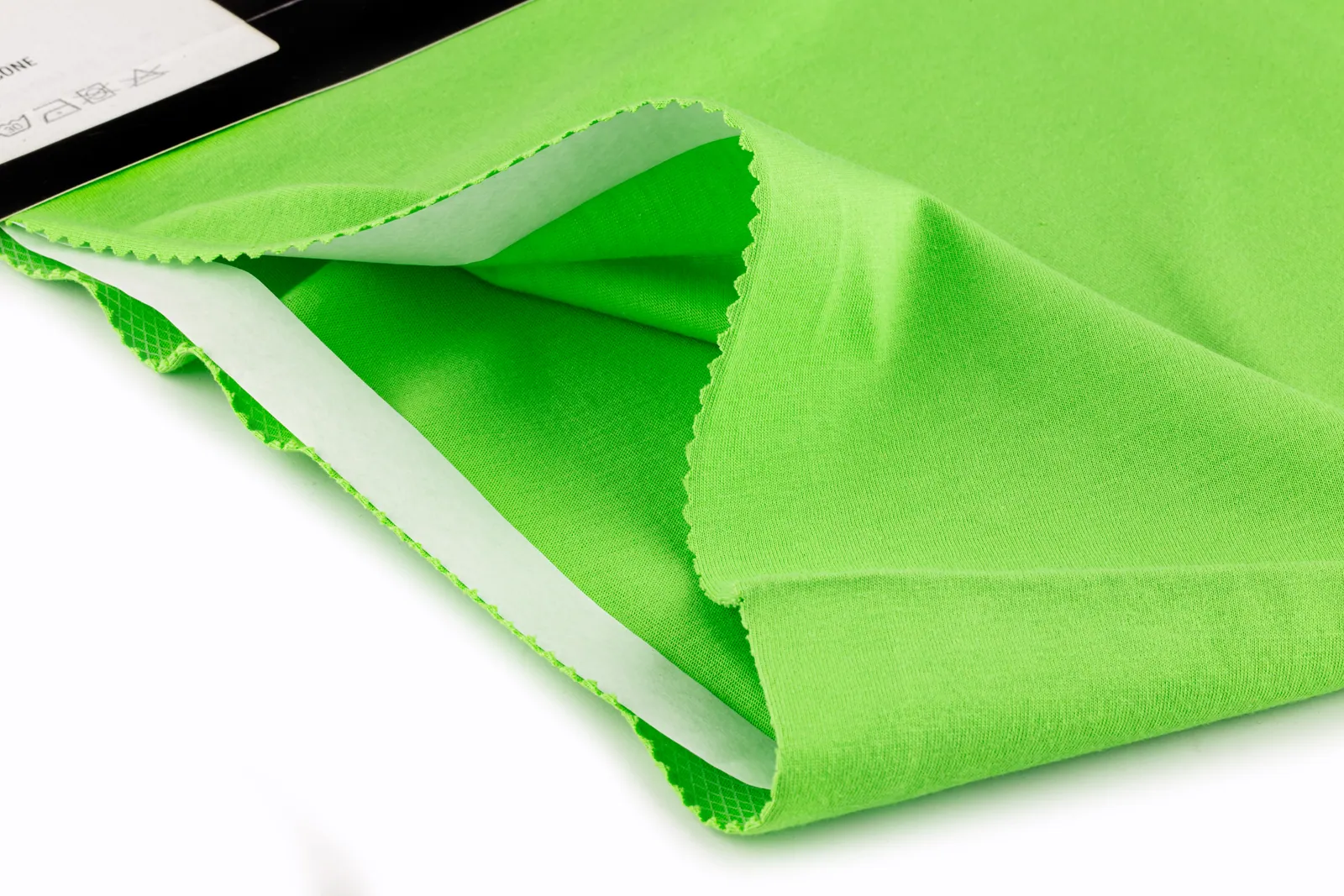
Fabric offers sometimes list plated jersey, vanisat in the Romanian trade. If you normally work with plain single jersey, the term can be confusing. It looks like ordinary jersey, with the same smooth face and looped back, but it behaves differently. It is worth knowing what it is and when it can help you make better t-shirts.
What plating means
In ordinary jersey, each loop is formed from a single yarn or a blended yarn. In plated jersey, the circular machine feeds two different yarns to the same needle at once, positioned so that one always appears on the face of the fabric and the other always on the back. The structure is still single jersey, but the two sides are made of different fibres.
The result is a fabric in which:
- the face has the look and feel of one fibre;
- the back has the properties of the other;
- the overall label composition is a blend, but the customer mainly sees and touches the face fibre.
Which fibre sits on the face and which on the back depends on the purpose of the fabric, so always check the spec sheet.
Why plating is used for t-shirts
Cotton and polyester plating gives combinations that are hard to achieve with a blended yarn:
- Cotton look and feel with polyester stability: the tee looks and feels like cotton but distorts less.
- More weight for the same yarn count: two yarns per loop make a fuller fabric, suited to heavier, more structured tees.
- Opacity: plated jersey is less see-through, which matters a lot in light colours and also in black tees worn in strong light.
- Sides with different jobs: in some technical fabrics one fibre picks up moisture from the skin and the other moves it outwards.
Concrete benefits for black tees
Black is a tricky colour for t-shirts. On 100% cotton, black can fade visibly after many washes and friction areas turn grey. A good plated jersey, dyed correctly for both fibres, can hold a more stable black and a cleaner surface over time. On top of that, a weight of around 220 GSM gives the tee good drape and a solid feel, which customers value in premium and relaxed-fit tees.
What to check on plated jersey
Because you are working with two fibres that behave differently, a few checks are essential:
- dyeing of both fibres: cotton and polyester take different dye classes; if one fibre is not fully dyed, the back shows through when the fabric is stretched, known as grinning, especially at seams;
- shrinkage: test it in length and width after washing;
- printing: if the face is cotton, screen printing and DTF work well, but control the curing temperature so the polyester does not release dye into light inks;
- labelling: the full composition with both fibre percentages must be declared under EU Regulation 1007/2011.
Cutting and sewing
Plated jersey is cut and sewn like any medium to heavy single jersey. Use ball-point needles of a suitable size, make sure the sewing thread matches both faces (not an issue in black) and test the neckband: on heavier fabrics, a very fine rib can look too thin by comparison. Many makers choose a rib of similar weight so the neck lies flat.
What we would use for a structured black tee
For a black tee with a full hand, in a regular or relaxed fit, which must stay black and keep its shape, we would choose a combed cotton and polyester plated jersey of around 220 GSM. Our black 220 g plated jersey is built for exactly this kind of product and is enzyme and silicone finished. If you would rather stay with pure cotton, you can compare it with the alternatives in our single jersey range.
This article is made to order at the group mill in Kahramanmaraș, in any of the 220 colours on our card, from 150 kg per colour. For the price per kilo and lead time, send us a quote request.
Frequently asked questions
Can you see the difference between plated and ordinary jersey?
At first glance, hardly at all: both have the same structure. The difference shows on the back, where the fibre is different, and in wear, through stability and opacity. An experienced eye also spots it when the fabric is stretched and the back yarn peeks between the loops.
Can plated jersey be sublimation printed?
Sublimation needs polyester on the printed face. If the face is cotton, sublimation will not work. Some plated articles are built the other way round, with polyester on the face, specifically for sublimation, which is why the spec sheet matters.
Is plated jersey warmer than plain jersey?
Being usually thicker and more compact, plated jersey can feel slightly warmer than a light plain jersey. Compared with a cotton jersey of the same weight, the difference in thermal comfort is small and depends mostly on the fibres used.