

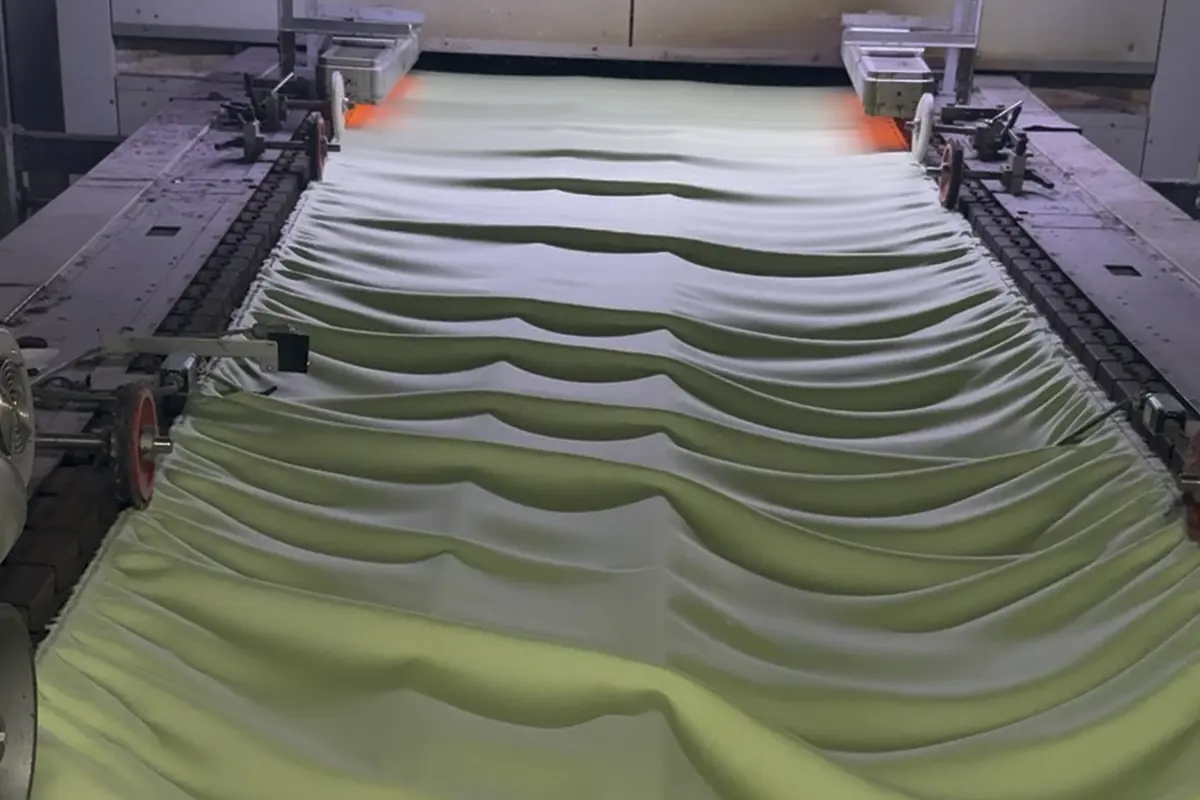
When you unroll knitted fabric, several kinds of irregularity can show up. Some are local and can be cut around; others repeat along the full length and compromise the roll. Knowing how to recognise them lets you decide quickly: cut, cut around the defect, or stop the roll and contact the supplier.
Barré: horizontal shade bands
Barré shows up as horizontal bands running along the courses, slightly lighter or darker than the rest of the fabric. The bands repeat at regular intervals, usually a few centimetres apart, and are easiest to see looking at the fabric at an angle under side light.
Common causes:
- yarns from different spinning lots, with different dye uptake, used on the same machine;
- differences in yarn tension between the feeders of a circular machine;
- yarns with slightly different count or twist.
Barré is hard to correct in dyeing and usually affects the whole roll. On saturated solid colours and smooth jersey it is very visible; on melange or printed fabric it shows much less. If it is visible at normal viewing distance, it is generally grounds for a claim.
Needle lines: vertical lines
Needle lines are fine lines running along the wales, lengthways down the roll, usually caused by a damaged or worn needle on the knitting machine. The line is continuous along the roll in the same position. It cannot be cut around unless it sits very close to the edge. A clearly visible needle line is normally a major defect.
Holes and dropped stitches
Holes have several possible causes: a broken needle, a yarn break during knitting, a knot, mechanical damage in finishing or in transit. Dropped stitches create a small ladder that can run. In the 4-point system, any hole gets the maximum points for that metre.
Isolated holes can be flagged and avoided at cutting. If holes appear frequently or at regular intervals, it is a production problem and the roll should be reported.
Contamination and foreign fibres
Coarse coloured fibres caught in the base yarn, such as black polyester in a white yarn or fibres of another colour, show as specks or short lines of a different colour, more visible after dyeing. On pale colours and white they are particularly annoying. A small, scattered amount may be tolerated; visible concentrations are grounds for a claim.
Stains, oil marks and dye streaks
- Oil marks from the knitting machine often appear as dark lines or spots, sometimes only visible after dyeing.
- Dye streaks, for example along the fold of tubular fabric, point to uneven dyeing or finishing.
- Shade differences between the edges and the centre, known as side-centre-side variation, show when you compare swatches from different points across the width.
Report these defects immediately. Do not try to clean stains with solvents in the workroom: they can leave bigger marks.
How to decide: a quick mental checklist
- Is the defect local and isolated? Flag it and cut around it.
- Does it repeat along the full length in the same position? It probably comes from the machine; stop the roll.
- Is it banded shade variation? Compare under side light and against the approved sample.
- Do defects exceed the agreed 4-point limit? Document and claim before cutting.
Example: tees in a saturated solid colour
Strong solid colours on smooth jersey are the most demanding at inspection, because any barré or needle line is immediately visible. A fabric such as emerald green single jersey at 160 g suits team tees, summer collections and colourful merch, but it is worth unrolling under side light on arrival, especially if rolls come from different lots. For made-to-order production, every lot is checked against the approved sample before dispatch.
You can see the rolls at our Afumați warehouse or order them from stock with no minimum. For other shades from our 220-colour card, send us a quote request.
Frequently asked questions
Can barré be removed by re-dyeing?
Usually not. Barré comes from yarn or tension differences in knitting, and re-dyeing, especially to a darker shade, can only soften it. Sometimes affected fabric can be used for all-over printed products, where the bands no longer show.
How many holes per roll are acceptable?
There is no universal number. Holes count in the 4-point system at maximum points, and acceptance depends on the total per area and the agreed limit. Holes repeating at regular intervals, however, signal a technical problem and should be claimed.
How can I see defects more easily on dark fabric?
Use side light, which throws surface irregularities into relief, and look at the fabric from different angles. On black and navy, needle lines and barré show better at an angle than head-on. Some workrooms use a strong torch held almost parallel to the fabric.


