
Every textile product made available on the EU market must state its fibre composition. The requirement comes from Regulation (EU) No 1007/2011 on textile fibre names and labelling, which applies directly in every member state, Romania included. For a small brand, that means the label sewn into a T-shirt is not a design element: it is a declaration with legal weight.
What the regulation says, in short
The regulation fixes three essentials:
- permitted names: only the fibre names listed in its annex may be used (cotton, polyester, elastane, viscose, modal, wool and so on), not trade names or invented ones;
- how to state them: fibres are listed in descending order of weight, with percentages;
- the label itself: durable, legible, visible and accessible, in the language of the member state where the product reaches the consumer.
Trade names may appear next to the official fibre name, never instead of it. Combed cotton is a fair quality description to add, but the fibre is still declared as cotton.
How to write a blend
Take a hypothetical case: a T-shirt made from a single jersey containing cotton, polyester and a little elastane. The supplier's spec sheet or a lab report shows, say, 60% cotton, 35% polyester, 5% elastane. The correct label reads:
- 60% cotton
- 35% polyester
- 5% elastane
Do not reverse the order because cotton sells better, and do not round figures to taste. The percentages must match the real composition of the fabric, within the manufacturing tolerances the regulation allows. If you do not have exact figures from your supplier, ask for them in writing before you order labels.
100%, pure and all
The terms 100%, pure or all may only be used for products made of a single fibre. The regulation tolerates a small amount of extraneous fibre that ends up in the product accidentally during processing, but it does not let you ignore elastane that was added on purpose. A T-shirt with elastane is not 100% cotton, however small the percentage.
Common mistakes we see
- Codes instead of names: CO/PES/EL is not enough for a consumer; the full fibre name has to appear in the local language.
- Invented names: premium soft-touch cotton is not a fibre.
- Composition copied from another style: if you changed the fabric, change the label.
- Only the main fabric listed: rib cuffs or a lining may be a different blend and need to be handled separately.
- English-only labels in other markets: for Romania, the information must be in Romanian.
- Non-textile parts of animal origin: if the product contains real leather or fur, the regulation requires a specific statement.
Where to get the correct data
The best source is the fabric specification sheet from the knitting mill, backed up where needed by a lab test. When you buy fabric, ask explicitly for the percentage composition per article and per lot. For blends, a composition test at an accredited lab is a small cost compared with the risk of a wrong label on several hundred pieces.
Keep a folder for each style: the fabric spec sheet, any lab report and the exact approved label text. If a customer or an authority asks, you can show where every figure came from.
Worked example: the grey melange tee
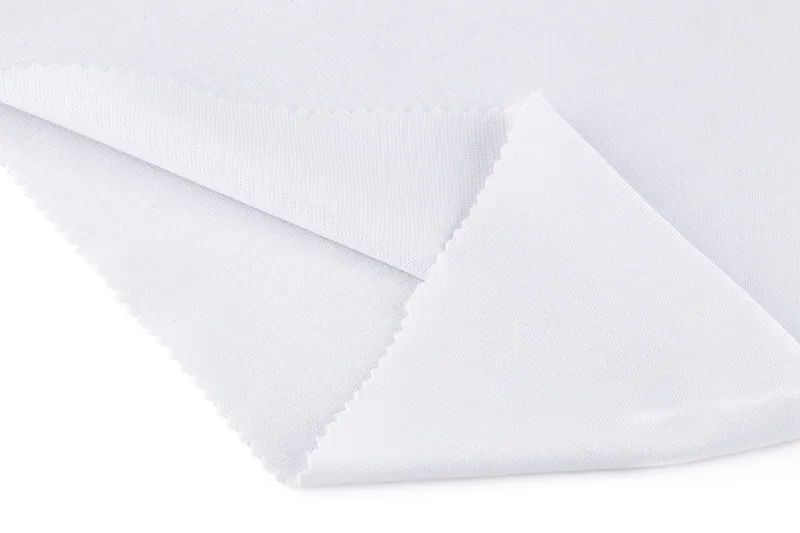
A unisex grey melange tee is the classic case where composition needs care, because the melange effect usually comes from mixing fibres. If you use our 180 g grey melange single jersey in combed cotton, elastane and polyester, you have a solid everyday T-shirt fabric with good recovery from the elastane, and the label must list all three fibres in order of weight. Before printing labels, ask for the exact percentages for the lot you received.
For comparison, the wider single jersey family includes 100% combed cotton qualities as well as blends with elastane or polyester. Your fabric choice decides what the label has to say.
Next steps
Fabrics in our Afumați stock are sold by the roll with no minimum, so you can run a small batch with a correct label from day one. For any of the 220 card colours, made-to-order production starts at 150 kg per colour per article. Ask for the spec sheet with your quote request and check the composition before your label order goes to print.
Frequently asked questions
Can I write the composition only in English if I also sell abroad?
You can use multilingual labels, but for products sold to consumers in Romania the information must also be in Romanian. Many brands print several languages on one label tape, one line per language, using the official fibre name in each language so every market is covered by the same label.
How exact do the label percentages have to be?
The regulation allows a manufacturing tolerance between declared and measured composition, but it does not let you declare approximately. Use the figures from the spec sheet or lab test and ask your supplier to confirm them for each lot, especially for blends containing elastane, where small differences are common.
Do I have to declare the sewing thread or the label itself?
Usually not. Under certain conditions the regulation allows you to exclude items such as sewing thread, labels and decorative tapes that are not an integral part of the product. Composition refers to the textile fabric of the product. Check special cases, such as visible trims in a different material.