

Many clothing-brand founders know what a tee costs them, but not how many tees they must sell for the brand to stop losing money. Break-even answers exactly that. It takes ten minutes with a pen and your own figures, and it shows straight away whether your plan is realistic or whether the price, the cost or the fixed spending needs to change.
Three terms you need
- Net revenue per piece: the selling price minus VAT (if you are registered), payment fees and average discounts.
- Variable cost per piece: everything you spend only if you make and sell the piece: fabric, labour, printing, labels, packaging and any share of shipping you absorb.
- Monthly fixed costs: what you pay however many pieces you sell: bookkeeping, the online shop platform, subscriptions, rent, a monthly ad budget, any salaries.
The difference between net revenue and variable cost is the contribution margin. It pays the fixed costs, and whatever is left after that is profit.
The formula
Break-even (pieces per month) = monthly fixed costs ÷ contribution margin per piece.
A T-shirt example
Let's assume a brand sells a printed tee at 119 lei including VAT. All figures are hypothetical and rounded.
- Net revenue per piece, after VAT, fees and occasional discounts: 90 lei.
- Variable cost per piece: fabric 9 lei, sewing 14 lei, printing 8 lei, labels and packaging 4 lei, partly absorbed shipping 5 lei. Total: 40 lei.
- Contribution margin: 90 − 40 = 50 lei per tee.
- Monthly fixed costs: bookkeeping 600 lei, platform and apps 200 lei, ads 2,000 lei, other 400 lei. Total: 3,200 lei.
- Break-even: 3,200 ÷ 50 = 64 tees a month.
At 64 tees a month the brand neither makes nor loses money. Every extra tee brings 50 lei of profit before tax; every tee short means a 50 lei loss.
Break-even on a production run
There is a second break-even point that matters just as much: how many pieces from a run you must sell to recover what you invested in it. Let's assume you make 200 tees at a cost of 35 lei each, so 7,000 lei. At 90 lei net revenue per piece, you recover the cost of the run after about 78 pieces. The other 122 pay for fixed costs and profit. If your size split is wrong and 60 pieces do not sell, that is the scenario to stress-test.
The levers that lower break-even
- Price: raising net revenue by 10 lei takes the margin to 60 lei and break-even to 54 tees a month. Price has the biggest effect, which is why positioning matters.
- Variable cost: an efficient marker and a fabric of the right width reduce cutting waste. Saving 0.02 kg of fabric per piece adds up over hundreds of pieces.
- Fixed costs: advertising is usually the largest fixed cost; measure what it brings in.
- Discounts: a 30% discount can halve your contribution margin. Use them to a plan, not in a panic.
Fabric and variable cost
Fabric is one of the largest parts of variable cost, but it is also what decides whether the tee earns good reviews. Cutting fabric quality to lower break-even is usually a false economy: returns and poor reviews cost you more. It is more effective to choose a fabric that cuts well and produces little waste.
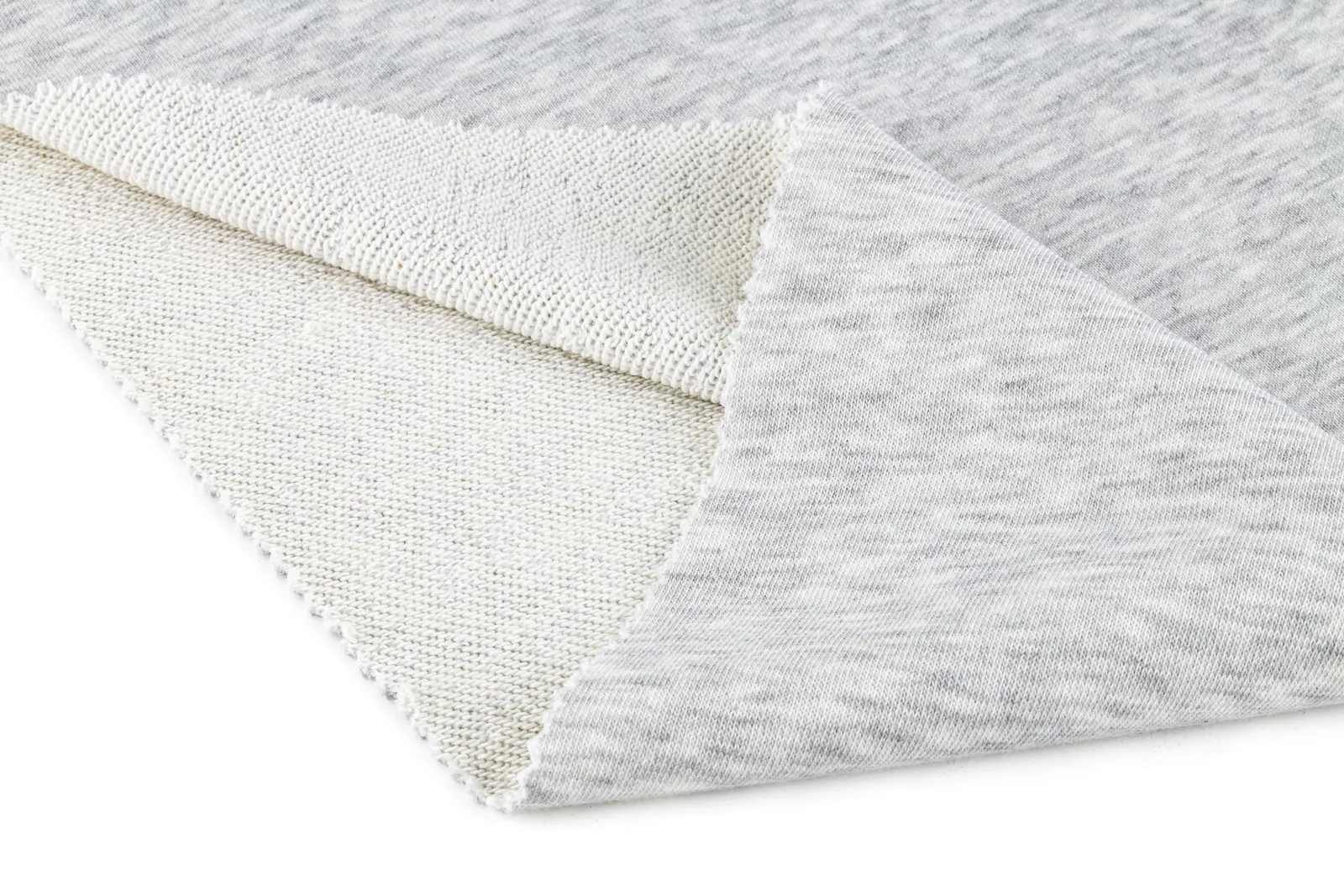
An example: a grey melange single jersey at 180 g with a 182 cm width allows an efficient pattern lay at cutting, and its combed cotton, elastane and polyester composition keeps it stable in the wash, which cuts returns for misshapen tees. Because it is a stock fabric, you never have to buy more than the run you have calculated. To compare other weights, look through our single jersey range.
How to use the calculation
Redo it whenever your price, supplier or ad budget changes. Put the monthly break-even figure next to actual sales in the same spreadsheet. If you are below break-even three months in a row, change something: price, cost, channel or product. To work with real fabric figures, ask for a price per kilo and calculate the cost per tee from actual consumption.
The figures in the examples are hypothetical and only illustrate the calculation. They are not Alteks Tricot prices: we quote the price per kg of each article on request, usually the same working day. Ask for a quote
Frequently asked questions
Are ads a fixed or a variable cost?
It depends on how you run them. If you have a fixed monthly ad budget, treat it as a fixed cost. If you pay commission per sale, for example to affiliates or marketplaces, that is a variable cost. What matters is that you neither forget them nor count them twice.
What if break-even looks impossible to reach?
Check the price first: small brands often underprice. Then cut fixed costs that do not bring sales and look for variable-cost savings that do not sacrifice fabric quality. If the numbers still do not work, you may need a different channel, product or audience.
Does break-even account for unsold stock?
The monthly figure does not. That is why you should also calculate break-even per run: how many pieces from a production you must sell to recover the money invested in it. Unsold stock does not show as an immediate loss in the accounts, but it is cash tied up and missing from your cash flow.


