

Wash shrinkage is one of the most common causes of complaints on hoodies. The customer buys a size M, washes it once and finds the sleeves shorter and the body riding above the waist. The problem is solved in three places: the fabric, the pattern and the care instructions.
Why knits shrink
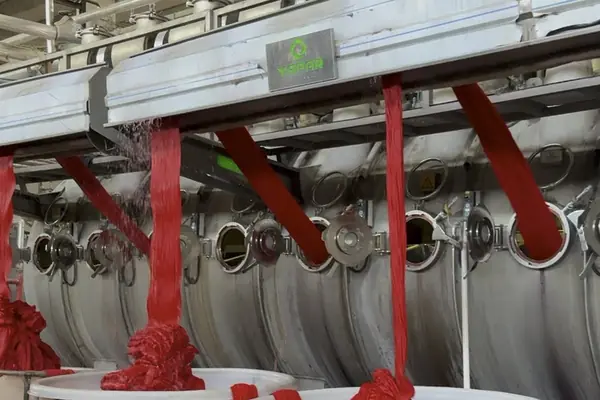
During knitting and finishing, fabric is pulled lengthways and held out across the width. Cotton fibres and knit loops are left in a forced state. At the first wash and dry, especially in a tumble dryer, they relax back towards their natural shape. The result: the fabric shortens in length and sometimes widens or narrows across the width.
Factors that increase shrinkage:
- high cotton content without stabilisation;
- a loose knit;
- finishing without compacting or adequate relaxation;
- hot washing and tumble drying.
Lengthways and widthways shrinkage
On hoodies, length matters most: body length and sleeve length. Accepted values for well finished hoodie fabrics are in the region of a few percent, and the exact tolerance is agreed contractually with the supplier. Ask your supplier for dimensional stability figures for each article and check them on your own samples.
Watch for spirality too: after washing, side seams can twist towards the front. It is most common on knits with a single face yarn and is controlled at fabric and cutting level, not just in sewing.
How to measure shrinkage on fabric
- Cut a 50 × 50 cm sample away from the selvedges.
- Mark a 35 × 35 cm square with a permanent marker and clear reference points.
- Wash the sample at the temperature you will put on the label and dry it the way the customer will, flat or tumble if you allow it.
- Remeasure the distances between marks in length and width.
- Shrinkage (%) = (original − final) / original × 100.
Repeat three times on different rolls. The average tells you how much to compensate.
How to build shrinkage into the pattern
If the fabric shrinks, for example, 4% in length and the finished hoodie must measure 70 cm after washing, extend the pattern lengthways: 70 / (1 − 0.04) ≈ 72.9 cm. Apply the same calculation to the sleeve and, where needed, to the width.
Practical rules:
- compensate body fabric and rib separately, because they shrink differently;
- repeat the test for every new fabric lot;
- check the sewn garment after washing, not just the fabric sample.
What to put on the care label
Care instructions must match your tests. If you tested at 30 °C with flat drying, do not print 40 °C and tumble dry. For fleece hoodies, typical advice is to wash inside out at moderate temperatures and avoid hot tumble drying. Care symbols should be clear and consistent with the tests you ran.
A concrete example
Let's assume a women's hoodie collection, regular fit, where customers complained with a previous supplier that sleeves shortened after washing. For the new collection we would use dusty pink brushed 3-thread fleece at 310 g/m²: the combed cotton and polyester blend is more dimensionally stable than 100% cotton fleece, and the enzyme, silicone, brushing and shearing finish gives a fine pile that stays pleasant through repeated washing. We would still recommend a wash test on the delivered lot and pattern compensation, as with any fabric.
Checklist for a hoodie that keeps its size
- Ask your supplier for dimensional stability figures per article.
- Run your own wash test on every lot.
- Compensate the pattern separately in length and width.
- Let fabric relax, unrolled, before cutting.
- Wash a finished garment and measure every point in the tech pack.
How to get the fabric
Fabrics from the 3-thread fleece family in stock are sold by the roll with no minimum, so you can run a wash test before committing to a large order. Every lot produced to order is checked against the approved sample. For questions about the stability of a particular article, get in touch.
Frequently asked questions
What shrinkage is acceptable on a hoodie?
There is no single universal figure. For well finished hoodie fabrics, length shrinkage is usually a few percent. Agree the tolerance in writing with your supplier and compensate for it in the pattern based on your own tests.
Does tumble drying increase shrinkage?
Yes. Heat and tumbling speed up the relaxation of fibres and loops. If you only tested with flat drying, do not recommend tumble drying on the label. Put on the label only what your real washing and drying tests confirmed.
Why has my side seam twisted after washing?
That is spirality, caused by yarn twist and knit structure. It is reduced through fabric choice and cutting on the correct grain, not through sewing. Check for it on every washed sample before approving a lot.