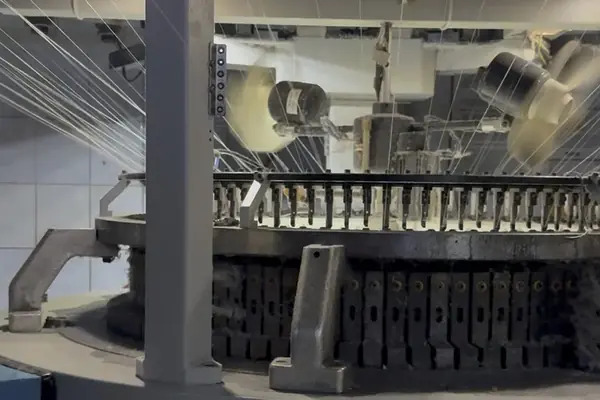
A pyjama looks like a simple product: two pieces, relaxed fits, almost no trims. That is exactly why customers judge it on the fabric alone. If it feels rough, twists after three washes or starts pilling, no amount of nice packaging will save it. Below we compare the knitted fabrics most often used for pyjamas and loungewear, from the point of view of a workshop or brand that has to sell in volume.
What matters in a pyjama fabric
Before comparing fabrics, decide what the garment has to do. For pyjamas the usual order of priorities is:
- feel against the skin: softness, no fuzz, seams that do not scratch;
- wash stability: low shrinkage and no twisting side seams;
- breathability: cotton and cellulose fibres absorb night-time moisture;
- drape: too stiff and it looks like a tracksuit, too limp and it clings;
- cost per set: fabric weight decides how many kilos go into each order.
Single jersey: the all-rounder
Single jersey is the base for most spring and summer pyjamas and for sleep tees. At 160–180 g/m² it balances coolness and opacity. Below about 150 g/m² light colours become see-through and the knees bag out; above 220 g/m² the garment starts to feel too warm to sleep in.
A 100% cotton jersey has a natural hand and takes print easily. Versions with elastane recover better after wear but need care at the cutting table, because the fabric can contract on the spread if it is not allowed to relax first. The classic jersey problem is side-seam twist after washing, which happens when the fabric was not properly stabilised during finishing.
Interlock, modal and viscose
Interlock is a double knit with the same face on both sides. It feels thicker for its weight, does not curl at the edges and is very stable, which is why it is the usual choice for children's pyjamas and bodysuits.
Modal blends have a silky hand and fluid drape that women's loungewear customers love. Pure viscose jersey is beautifully cool in summer but shrinks more and needs careful cutting. Both are worth considering for premium or summer ranges, provided you run wash tests before production.
Brushed fleece and brushed jersey
In winter, customers want warmth. Brushed 3-thread fleece at 250–340 g/m² has a soft napped back and keeps you warm without feeling heavy. It is bulkier, though, and suits lounge sets better than pyjamas you actually sleep in.
A less familiar middle ground is peached jersey: a single jersey lightly brushed on the surface to give a suede-like touch. It stays thin and breathable, yet feels warmer and more expensive in the hand than standard jersey. It is a good pick for autumn ranges and for customers who say ordinary cotton feels cold.
What we would use for an autumn pyjama
Let's assume you are planning a unisex cold-season pyjama with a long-sleeve top and full-length trousers. We would suggest our stone grey 180 g peached jersey in 100% combed cotton: the weight is right for sleeping, the cotton breathes, and the carbon-brushed finish gives the soft surface shoppers notice the moment they touch it. At around 185 cm wide it also allows efficient marker making for the larger sizes.
For the winter lounge set in the same range, you could pair it with rib cuffs and a brushed fleece trouser in the same shade from the colour card.
How to choose in practice
- Fix the season and retail price before the fabric.
- Ask for swatches of two or three options and wash them at least three times at the temperature you will put on the care label.
- Measure shrinkage in length and width and check for twist.
- Sew a complete prototype, not just a swatch, and sleep in it for a few nights.
- Only then cost the set and order the quantity.
This peached jersey is made to order in any of the 220 card colours, from 150 kg per colour. If you need small quantities to start, ask for our current stock list of fabrics available immediately with no minimum, or send an enquiry with the weight and colours you have in mind.
Frequently asked questions
What weight of jersey is right for summer pyjamas?
For summer, a jersey of roughly 150–170 g/m² is usually enough: it stays cool without turning see-through in light colours. Below 140 g/m², check opacity on a prototype, especially for trousers and pastel shades, before committing to bulk.
Is 100% cotton or cotton with elastane better for pyjamas?
Pure cotton breathes very well and has a natural hand, so it is preferred for relaxed fits. Elastane helps the fabric spring back at knees and elbows, which matters for slimmer cuts. For loose pyjamas, elastane is a nice extra rather than a requirement.
What does peached jersey mean?
It is a jersey whose surface has been finely brushed during finishing, usually with special rollers, so it gains a very short layer of fibre. The result is a suede-like touch and a warmer feel without noticeably increasing the fabric weight.