

Almost every company orders promotional t-shirts at some point: for a trade fair, a campaign, a product launch or loyal customers. For suppliers, whether a print shop, a garment workshop or a promotional products agency, these are frequent and profitable orders, provided they are well planned. For the client company the aim is simple: tees that people wear, not ones that end up as dusters. Here is a process that works for both sides.
Step 1: be clear about what the tee is for
The first question is not what colour, but who will wear it and where. The answer shapes everything else:
- a giveaway at an event, worn for one day: price and logo visibility matter most;
- a gift for clients: hand feel and a discreet design matter, otherwise it will not be worn;
- a tee for promotional staff: wash durability and a large logo visible from a distance matter;
- a tee sold in the company's own shop: near-retail quality and a good fit matter.
A cheap tee with a huge logo will not be worn outside the event. A good tee with a design people actually like advertises the brand for months.
Step 2: budget per piece, not total budget
Companies usually start from a total budget. Convert it straight away into a budget per piece, then break it down. A hypothetical example: a budget of €2,000 for 400 tees means €5 per piece, which has to cover fabric, cutting and sewing, printing, packing, delivery and the supplier's margin. If a front and back print will not fit within that, suggest a single print position or a design with fewer colours, rather than a poorer fabric.
Step 3: the size split
The most common mistake is guessing sizes. The result is dozens of leftover smalls and no XLs. Practical fixes:
- ask the company for the real list of people if the tees are for employees;
- for public events, use a cautious curve weighted towards M, L and XL, and agree it with the client in writing;
- suggest a 3–5% buffer for exchanges;
- if there is a women's style, agree a separate curve for it.
Step 4: artwork and approval
Send the client a proof showing the exact position and size of the logo in centimetres, the ink colours and the garment colour. Get written approval. For large orders, produce a physical sample and photograph it next to a ruler. Every conversation along the lines of the logo should have been bigger that you avoid now saves you a reprint at your own expense.
Step 5: plan backwards
Start from the event date and work back:
- delivery 3–5 days before the event, to allow for corrections;
- printing and packing;
- garment making;
- fabric supply;
- artwork and sample approval.
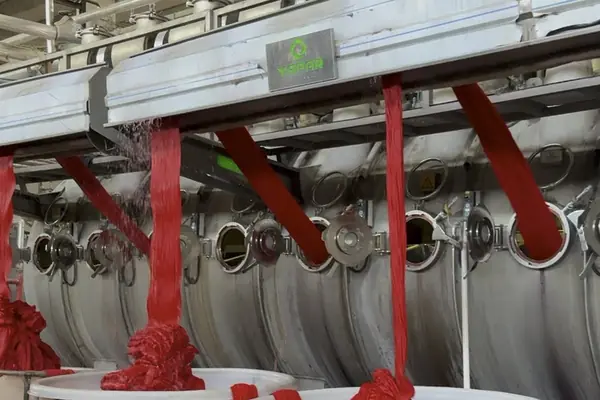
If the fabric has to be made to order in an exact corporate colour, include time for the lab dip, dyeing and transport. If the deadline is tight, choose the closest stock colour to the brand colour instead.
Step 6: packing and delivery
Ask the client how they want the tees delivered: individually bagged, by size, by department or by location. Label cartons clearly with size and quantity. For deliveries to several cities, agree in advance who pays for transport.
What we would use for promotional tees
For promo tees that need to look neat and be worn after the event, we would choose our 155 g anthracite melange single jersey in combed cotton and polyester. At 155 g/m² it keeps cost under control and is comfortable in summer, the combed cotton gives a pleasant surface, and the polyester helps the tee keep its shape after washing. The anthracite melange shade works with white, yellow or coloured logos printed by DTF or plastisol screen printing.
The 155 g anthracite melange jersey is in stock in Afumați, sold by the roll with no minimum order. For an exact corporate colour, we produce to order from 150 kg per colour, with a lab dip. Ask for the stock list or send a quote request, and if you want to see the colours in person, our showroom in Afumați is open to trade buyers.
The figures in the examples are hypothetical and only illustrate the calculation. They are not Alteks Tricot prices: we quote the price per kg of each article on request, usually the same working day. Ask for a quote
Frequently asked questions
How far in advance should promotional tees be ordered?
It depends on quantity, decoration method and whether the fabric is in stock or made to order. To be safe, start the conversation several weeks ahead and plan backwards from the event date, leaving room for approvals and transport.
Which promotional tee colour gets worn most?
Neutral colours such as black, navy, grey melange or anthracite are worn most after the event. Very bright colours stand out on the day but are worn less afterwards. A good compromise is a neutral tee with the logo in the brand colour.
Can I order the same tee in several colours?
Yes, but each colour needs its own size split and, for screen printing, sometimes different ink colours. For small orders, stick to one or two colours to keep cost and complexity under control and avoid leftovers.