
Fibres & yarns
Open-end, combed and compact cotton, polyester, elastane, modal, recycled.
52 articles Fibres & yarns
What is the difference between ring-spun and open-end yarn?
Ring-spun yarn is twisted continuously on a ring frame, which gives a finer, stronger and softer-feeling yarn.
 Fibres & yarns
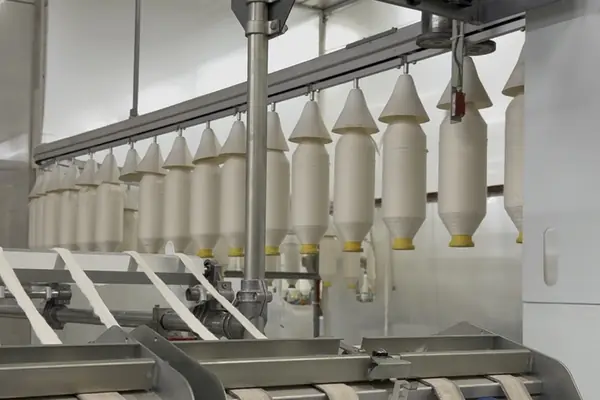
What do carded cotton and combed cotton mean?
Carded cotton goes only through the carding machine, which aligns the fibres and removes large impurities; the yarn stays hairier, with short fibres and more…
 Fibres & yarns
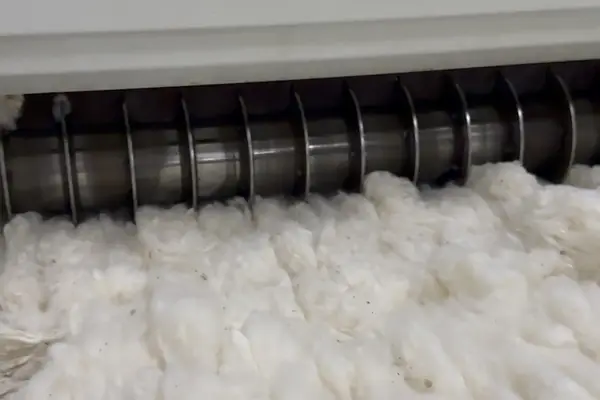
What is compact yarn and when is it worth it?
Compact yarn is a ring-spun yarn in which the fibres are condensed before twisting, so it has less hairiness and is stronger and smoother.
 Fibres & yarns
What does Ne mean for yarns and how do you read it?
Ne (English cotton count) is the numbering system for cotton yarns: it tells how many 840-yard hanks weigh one pound.
 Fibres & yarns
Which yarn count (20/1, 30/1, 40/1) is used for T-shirts?
For everyday single jersey T-shirts, Ne 24/1 to 30/1 is most common at medium weights, and Ne 30/1 to 40/1 for fine, summer or premium tees.
 Fibres & yarns
What does 30/2 or 30/30 mean in a knitted fabric specification?
The notation 30/2 means two Ne 30 strands twisted together, so the resulting yarn is roughly equivalent to Ne 15, thicker and stronger.
 Fibres & yarns
How do I read a specification like 30/1 + 40D elastane?
In 30/1 + 40D, the first part is the cotton yarn (Ne 30, single), and 40D is the elastane expressed in denier, meaning the fineness of the elastic thread.
 Fibres & yarns
What is Pima or Supima cotton?
Pima is an extra-long staple cotton grown mainly in the USA, Peru and Australia.
 Fibres & yarns
What is Egyptian cotton and is it always better?
Egyptian cotton (Giza) is a long or extra-long staple cotton grown in Egypt, valued for fineness and lustre.
 Fibres & yarns
What is organic cotton and how does it differ from conventional cotton?
Organic cotton is grown without synthetic pesticides and fertilisers and without genetically modified seed, under recognised standards.
 Fibres & yarns
What is recycled cotton and how much recycled content does it usually have?
Recycled cotton comes from textile waste, usually cutting and knitting offcuts, shredded back into fibres and respun.
 Fibres & yarns
What does Better Cotton (BCI) mean on a T-shirt?
Better Cotton is a programme for more responsible farming; it is not an organic certification and does not guarantee a specific type of fibre.
 Fibres & yarns
What is the difference between virgin polyester and recycled polyester (rPET)?
Recycled polyester (rPET) is usually made from collected PET bottles, melted and turned into fibres or yarns.
 Fibres & yarns
What is CVC and how does it differ from PC?
CVC (Chief Value Cotton) is a blend where cotton predominates, typically 60 to 80 percent cotton and the rest polyester.
 Fibres & yarns
What is a triblend and which fibres is it made from?
A triblend is a fabric made from three fibres, most often cotton, polyester and viscose (or modal), in a blended yarn.
 Fibres & yarns
How much elastane (Lycra) goes into a knit and what does each percentage change?
The most common levels are 2 to 5 percent elastane for comfort single jersey and rib, around 5 to 10 percent for very stretchy articles such as leggings or…
 Fibres & yarns
Does elastane lose its elasticity over time?
Yes, elastane can age: after many years, or after repeated exposure to high heat, chlorine and some light, the elastic thread weakens, the fabric becomes saggy and…
 Fibres & yarns
What is modal and how does it differ from cotton?
Modal is a regenerated cellulose fibre made from beech wood pulp, with a very soft hand, fine lustre and fluid drape.
 Fibres & yarns
What is viscose and what problems can it cause in knitwear?
Viscose is a regenerated cellulose fibre made from wood pulp, with a soft hand, fluid drape and good moisture absorption.
 Fibres & yarns
What is lyocell (Tencel) and is it different from viscose?
Lyocell is also a regenerated cellulose fibre, but made in a closed-loop solvent process.
 Fibres & yarns
Is it true that bamboo T-shirts are antibacterial and natural?
Usually a bamboo T-shirt is actually bamboo viscose, a regenerated cellulose fibre, not a natural bamboo fibre.
 Fibres & yarns
What is nylon (polyamide) used for in knitwear?
Nylon, or polyamide, is a synthetic fibre that is very resistant to wear and abrasion, light and elastic.
 Fibres & yarns
Can single jersey be made with linen and how does it behave?
Yes, single jersey with linen exists, usually blended with cotton or viscose, for example 55 percent linen and 45 percent cotton.
 Fibres & yarns
Can single jersey be made with wool and how does it behave?
Yes, single jersey with wool exists, often blended with cotton, viscose or polyester, for example 30 to 50 percent wool.
 Fibres & yarns
What does melange (heather) mean in knitwear and how is it made?
Melange is a mixed-shade appearance with a slightly speckled yarn effect, typical of heather grey.
 Fibres & yarns
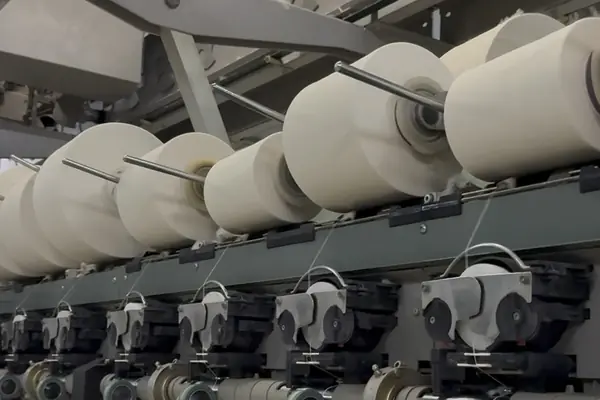
What is siro yarn and what is its advantage?
Siro yarn is a yarn in which two rovings are spun together on the same spinning unit, giving an appearance close to a two-ply yarn but without the cost of a…
 Fibres & yarns
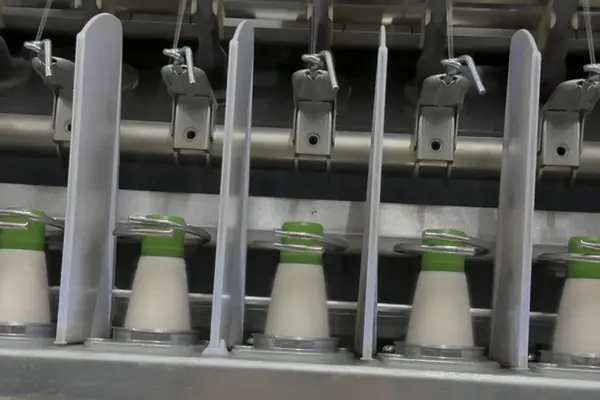
What is slub yarn and what does the fabric look like?
Slub yarn is a yarn with deliberate thick and thin places created during spinning.
 Fibres & yarns
How does yarn twist influence spirality in knitted fabric?
A single ring yarn is twisted in one direction, and the knit tries to release that twist, which can rotate the wale lines and produce spirality, meaning side seams…
 Fibres & yarns
Why does combed yarn pill less?
Pilling occurs when short fibres work their way to the surface and tangle into small balls.
 Fibres & yarns
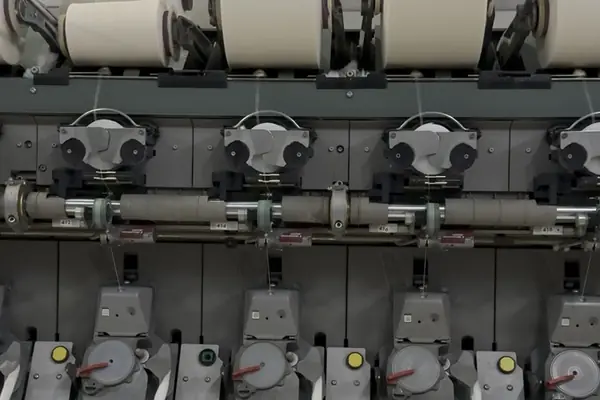
How do I read a fabric composition label correctly?
Composition is written in percentages, in descending order, adding up to 100 percent.
 Fibres & yarns
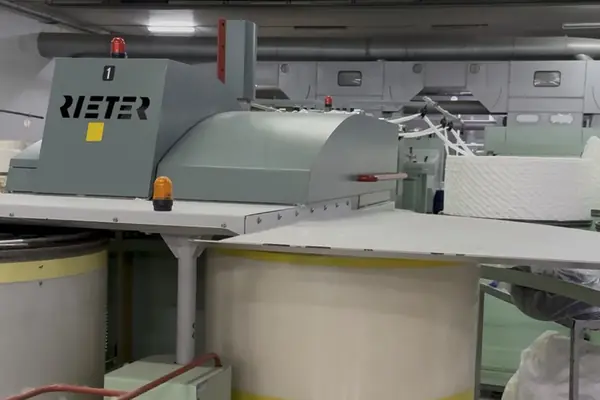
What is cotton staple length and why does it matter?
Staple length is the average length of the cotton fibres.
 Fibres & yarns
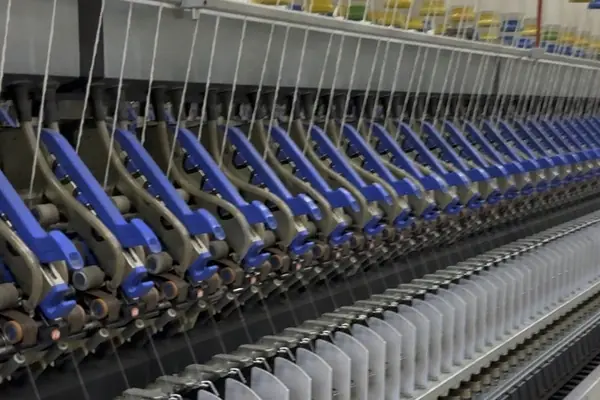
What are the differences between cotton and polyester fibres?
Cotton is a natural fibre that absorbs moisture, feels pleasant and is breathable, but it creases and dries more slowly.
 Fibres & yarns
Why does polyester pill, and why don't the pills fall off?
Polyester fibres are very strong, so when a fibre end pokes out and tangles into a ball, it does not break easily and the pill stays attached to the fabric.
 Fibres & yarns
How do I convert between Ne, Nm, tex and denier?
Ne refers to cotton, Nm is the metric count (metres per gram), tex is the mass in grams per 1000 m, and denier is the mass in grams per 9000 m.
 Fibres & yarns
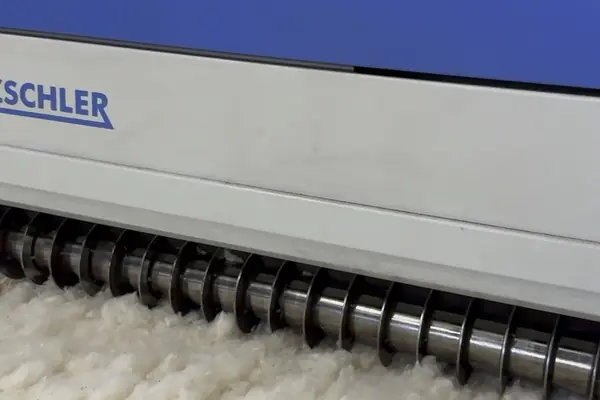
What is textured polyester (DTY) compared with spun polyester yarn?
Textured polyester (DTY) is a continuous filament yarn that has been crimped for bulk and stretch.
 Fibres & yarns
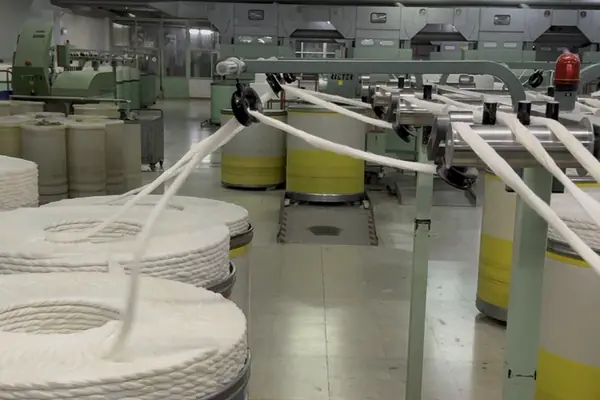
What are neps and why do they appear in knitted fabric?
Neps are small knots of tangled fibres in the yarn, appearing especially when the cotton is short, immature or poorly carded.
 Fibres & yarns
What does yarn hairiness mean and how does it affect the fabric?
Hairiness is the number and length of fibre ends sticking out of the yarn body.
 Fibres & yarns
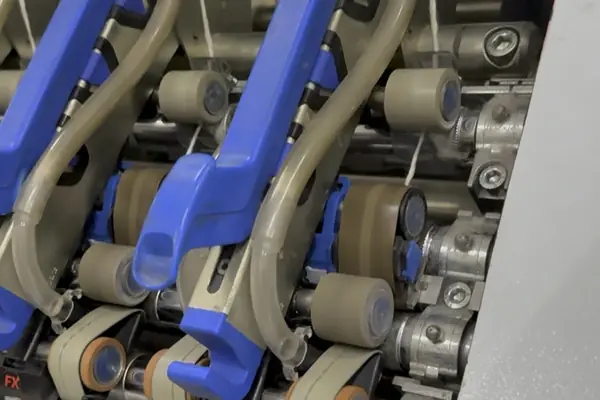
What is the barré effect and can it come from the yarn?
Barré is a horizontal stripe, visible as a shade or appearance difference across the width of the fabric.
 Fibres & yarns
Why does viscose shrink more than cotton?
Viscose fibre swells strongly in water and is weaker when wet, so the knit structure relaxes and shrinks more than cotton.
Fibres & yarnsWhat does a cotton–modal blend add over pure cotton?
A cotton–modal blend, for example 50/50, gives the cotton fabric more softness, a more fluid drape and fine lustre, and colours often look more vivid.
Fibres & yarnsCan knitwear be made with hemp and what are its characteristics?
Yes, hemp knits exist, usually blended with cotton or viscose, because pure hemp is stiff.
Fibres & yarnsWhat is acrylic in knitwear and how does it compare with wool?
Acrylic is a synthetic fibre used to imitate wool: it is light, warm, soft and cheaper.
Fibres & yarnsWhat is polyester microfibre and how does it feel in knitwear?
Polyester microfibre is a very fine fibre, under about 1 denier per filament, giving a softer, denser fabric with a peach-skin or silky hand.
Fibres & yarnsHow can I find the composition of a knit with a burn test?
A burn test gives only a rough indication of the fibre family.
Fibres & yarnsWhat tolerance is accepted for the composition on a label?
The EU textile fibre labelling regulation accepts a manufacturing tolerance of 3 percent against the declared percentages, meaning a small difference between the…
Fibres & yarnsWhat is the difference between an intimate blend yarn and two different yarns in one fabric?
In an intimate blend yarn, the fibres (for example cotton and polyester) are mixed before spinning, so every strand contains both fibres.
Fibres & yarnsWhat does 100% premium cotton mean?
Premium is not a standardised category: it is a marketing word that can mean different things.
Fibres & yarnsWhich yarns are used for the brushed inside of a hoodie?
For fleece and the brushed inside of a sweatshirt (3-thread), a finer base yarn is normally used on the outer face and a thicker, lower-twist yarn for the inner…
Fibres & yarnsHow much moisture does each fibre absorb?
Fibres differ widely in moisture regain: cotton absorbs about 8 percent, viscose and modal more, wool around 13 to 16 percent, polyester and acrylic very little,…
Fibres & yarnsWhy do synthetic knits produce static electricity?
Synthetic fibres, especially polyester and acrylic, absorb very little moisture, so electric charges cannot drain away and build up through friction.
Fibres & yarnsWhat is bicomponent polyester (elastomultiester, T400) compared with elastane?
Elastomultiester is a bicomponent polyester yarn made of two polymers that shrink differently and form a spiral crimp, giving stretch without elastane.
Fibres & yarnsWhich yarn count is used for sweatshirts and heavy knits?
For medium and heavy sweatshirts and french terry, thicker yarns are used than for T-shirts: usually Ne 16/1 to 30/1 for the outer face, and for the brushed or…
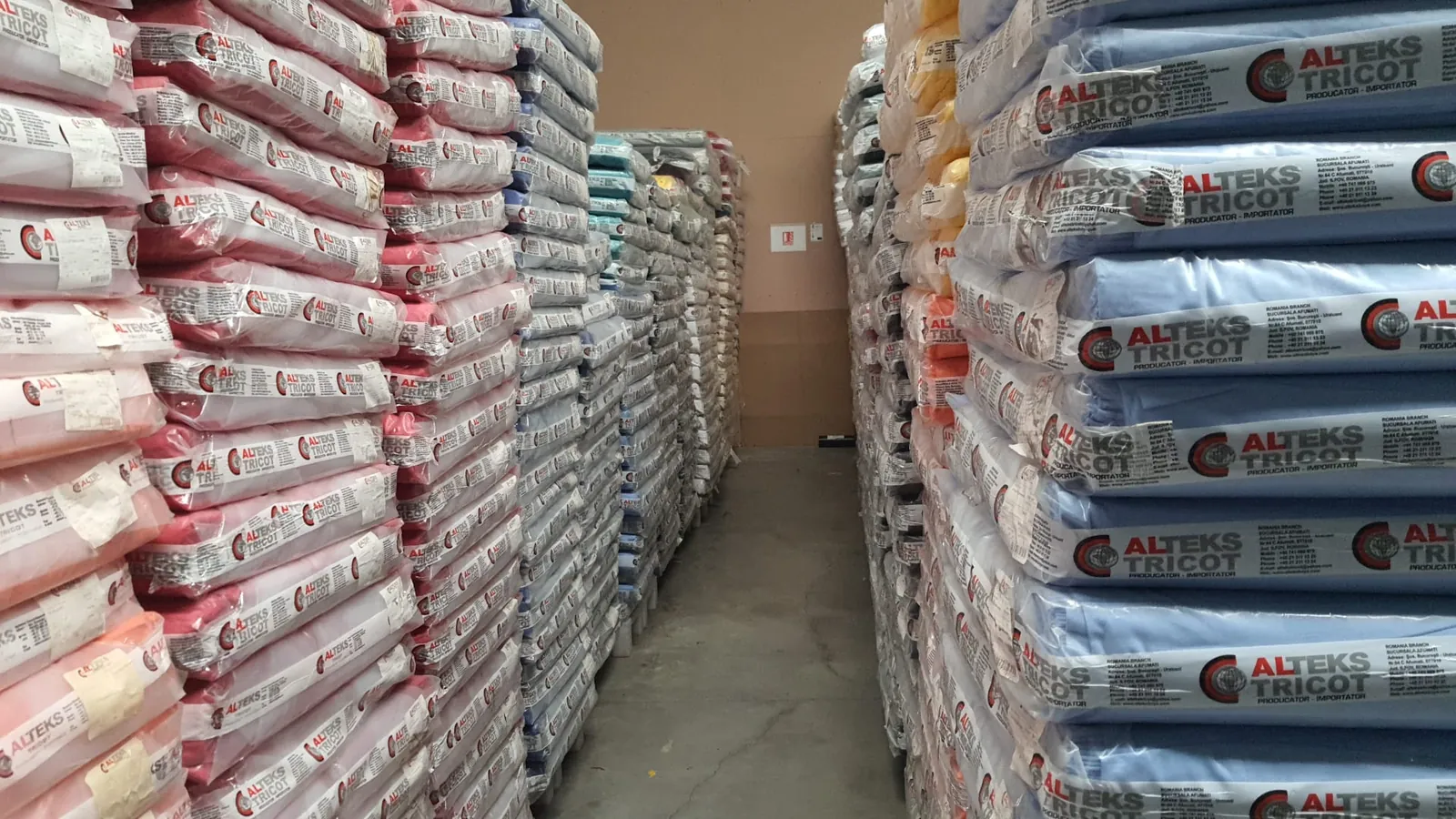
From stock, no minimum order.
Take exactly what you need from our Afumați stock — one roll or a pallet. Ask for the current stock list and get it on WhatsApp or by email.
 0 kg minimum