
Weight, width & measurement
GSM, tubular width, shrinkage, metres per kilo, consumption per garment.
52 articles Weight, width & measurement
What does GSM mean for knitted fabric?
GSM stands for grams per square metre and tells you how much one square metre of finished knitted fabric weighs.
 Weight, width & measurement
How do I convert GSM to oz/yd² and back?
To convert GSM to ounces per square yard, divide by 33.9; to go the other way, multiply by 33.9.
 Weight, width & measurement
What is ounces per linear yard and how do I convert it to GSM?
Ounces per linear yard (oz/ly) is the weight of one yard of fabric across its full width, so it depends on the width.
 Weight, width & measurement
How do I measure GSM with a GSM cutter?
A GSM cutter punches out a disc of exactly 100 cm² (0.01 m²).
 Weight, width & measurement
How can I calculate GSM with just a ruler and a kitchen scale?
Cut a square of 20 × 20 cm (400 cm², or 0.04 m²), weigh it and multiply the weight in grams by 25.
 Weight, width & measurement
Where on the roll should I cut the sample for a GSM check?
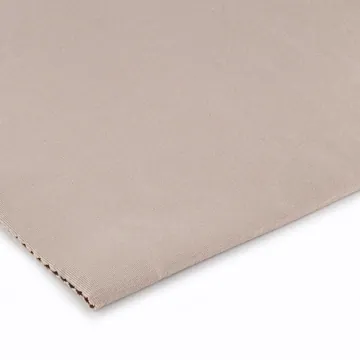
Cut the sample from at least three points across the width (left, centre, right), at least 10 cm from the edge, and from a spot a few metres in from the end of the…
 Weight, width & measurement
Does GSM change between greige and finished fabric?
Yes, finished fabric is usually heavier per square metre than greige (raw) fabric.
 Weight, width & measurement
How does GSM change after washing?
After washing, knitted fabric shrinks in length and width, so the same amount of material covers a smaller area and the GSM goes up.
 Weight, width & measurement
What GSM does a normal single jersey t-shirt have?
A classic single jersey t-shirt is usually between 140 and 200 GSM, most often 160 to 180 GSM.
 Weight, width & measurement
What GSM should I choose for hoodies and sweatshirts?
French terry (2-thread) hoodies are typically 240 to 330 GSM, while 3-thread fleece with a brushed inside is typically 260 to 380 GSM.
 Weight, width & measurement
What GSM do pique polo shirts usually have?
Pique polo shirts typically weigh 180 to 240 GSM.
 Weight, width & measurement
What GSM is used for leggings, joggers and sportswear?
For leggings and sportswear the typical range is 180 to 280 GSM, with elastane.
 Weight, width & measurement
What counts as lightweight, midweight and heavyweight GSM?
There is no official boundary, but in practice for single jersey under 140 GSM is light, 140 to 200 GSM is medium and over 200 GSM is heavy.
 Weight, width & measurement
From what GSM is a t-shirt heavyweight (oversized, boxy)?
In the current heavyweight and oversized tee trend, a t-shirt counts as heavy from about 220 GSM; boxy streetwear tees usually use 240 to 280 GSM and some reach 300…
 Weight, width & measurement
From what GSM is a hoodie considered heavyweight?
A hoodie is considered heavyweight from about 350 GSM; between 400 and 500 GSM people speak of very heavy hoodies in the premium streetwear or American vintage…
 Weight, width & measurement
What is the difference between tubular and open-width knitted fabric?
Tubular fabric comes off the circular knitting machine as a tube and is delivered folded flat.
 Weight, width & measurement
How do I read the width on a tubular roll label?
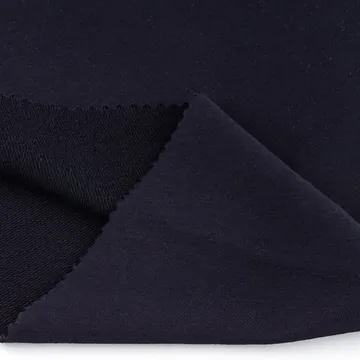
On a tubular roll label, the stated width is usually that of the tube laid flat, not the fabric opened out.
 Weight, width & measurement
What is the usable width of a fabric?
Usable width is the part of the total width you can actually use when cutting.
 Weight, width & measurement
What are the advantages of cutting from tubular fabric?
Cutting from tubular allows pieces without a side seam, for example a tee body made as one piece around the body.
 Weight, width & measurement
How do I measure the width of knitted fabric correctly?
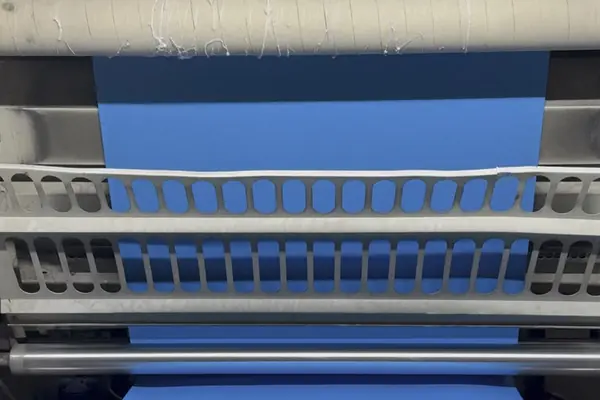
Lay the fabric on a flat table with no stretching and no waves, and measure from edge to edge at right angles to the length.
 Weight, width & measurement
What is a normal GSM tolerance (±5%)?
In the knitted fabric trade, a tolerance of ±5% on GSM is very common; some buyers ask for ±3%, and for basic or made-to-order fabrics up to ±10% is sometimes…
 Weight, width & measurement
What width tolerance is accepted for knitted fabric?
For fabric width, ±2 to 3 cm or around ±3 to 5% is usually accepted, depending on the supplier and the knit type.
 Weight, width & measurement
How do I convert kilograms of fabric into metres?
The formula is: metres = kg × 1000 ÷ (GSM × width in metres).
 Weight, width & measurement
How do I calculate the kilograms needed from a number of metres?
The formula is: kg = metres × GSM × width in metres ÷ 1000.
 Weight, width & measurement
How do I calculate metres per kilogram for tubular fabric?
For tubular, take the flat tube width and double it: metres per kg = 1000 ÷ (GSM × 2 × flat tube width in metres).
 Weight, width & measurement
How much does a linear metre of fabric weigh (grams per metre)?
The weight of a linear metre is the GSM multiplied by the width in metres.
 Weight, width & measurement
How much does a roll of knitted fabric weigh and how many metres is it?
Rolls of circular knit fabric usually weigh 15 to 35 kg, but the weight depends on the supplier, the fabric type and the packing method.
 Weight, width & measurement
What is the difference between net and gross weight on fabric rolls?
Net weight is the weight of the fabric alone; gross weight also includes the packaging: the film, the cardboard core the fabric is wound on and possibly a bag or…
 Weight, width & measurement
Why do two rolls of the “same” fabric weigh differently?
Because rolls are not identical: they can have different lengths, slightly different widths, GSM values within tolerance and different moisture content.
 Weight, width & measurement
How does moisture affect fabric weight?
Fibres absorb moisture from the air, so the weight of a fabric changes with its environment.
 Weight, width & measurement
How many t-shirts can I make from one kilogram of knitted fabric?
An adult size M t-shirt in 160 to 180 GSM single jersey usually uses 0.18 to 0.25 kg of fabric, so one kilogram makes about 4 to 5 pieces.
 Weight, width & measurement
How many hoodies can I make from a 25 kg roll?
An adult hoodie with a hood, pocket and long sleeves usually uses 0.6 to 0.9 kg of fabric, plus 0.05 to 0.1 kg of rib for cuffs and hem.
 Weight, width & measurement
How much fabric does a tee, a polo, a hoodie and joggers use?
Indicative values for an adult size M: single jersey tee at 160 to 180 GSM, 0.18 to 0.25 kg; pique polo at 200 GSM, 0.25 to 0.32 kg; french terry hoodie at 300 GSM,…
 Weight, width & measurement
How much fabric should I order for 1,000 t-shirts?
Start from consumption per piece: 0.22 kg per size M tee in 180 GSM single jersey.
 Weight, width & measurement
What is a normal marker efficiency and how much is lost in cutting?
Marker efficiency is the percentage of fabric that ends up in garment pieces; the rest is waste.
 Weight, width & measurement
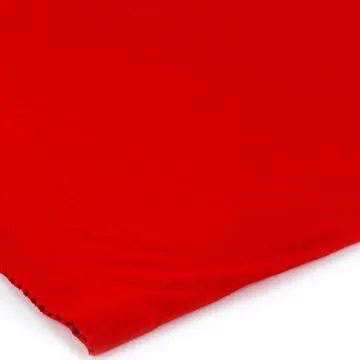
What shrinkage is normal for cotton knitted fabric?
For finished, pre-shrunk cotton knit, shrinkage of 3 to 5% in length and 2 to 4% in width after the first wash is considered normal in the trade; many brands accept…
 Weight, width & measurement
How do I calculate the shrinkage percentage?
Mark three pairs of reference points at a known distance on the fabric sample, in both length and width, for example 35 cm.
 Weight, width & measurement
How is dimensional stability tested (ISO 6330, ISO 5077)?
Dimensional stability is usually tested with ISO 6330 (washing and drying under standard conditions at a chosen temperature, for example 40 °C) and the measurement…
 Weight, width & measurement
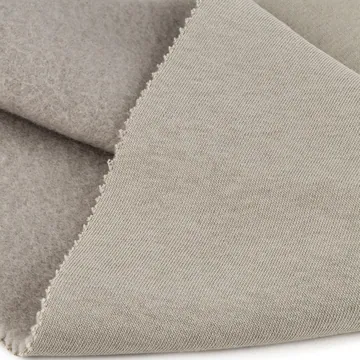
How do I compensate for shrinkage in cutting patterns?
Divide the target dimension by the shrinkage factor.
 Weight, width & measurement
Should I let the fabric relax before cutting?
Yes, it is recommended.
 Weight, width & measurement
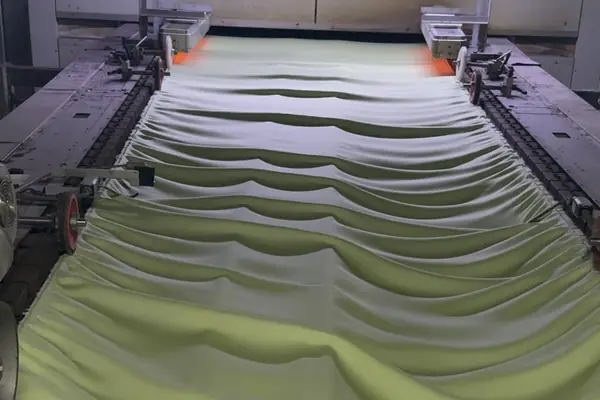
What is spirality (torque) in knitted fabric and how is it measured?
Spirality, also called torque, is the rotation of the wale lines relative to the side seam after washing: the tee twists around the body and the side seam moves…
 Weight, width & measurement
What spirality value is acceptable?
Many buyers accept up to 5% spirality after washing; some ask for less, for example 3%, for premium products or garments with a visible side seam.
 Weight, width & measurement
How do I test the stretch of a knitted fabric?
Mark a 10 cm reference on the fabric in the direction to be tested (width or length), stretch it to the normal limit of wear or with a set weight and measure the…
 Weight, width & measurement
What are elastic recovery and growth in knitted fabric?
Elastic recovery is the ability of the fabric to return to its original size after stretching.
 Weight, width & measurement
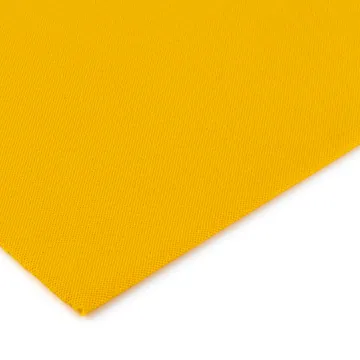
How does elastane change fabric width and GSM?
Elastane makes the fabric pull in, so the finished width is smaller and the GSM higher than for the same fabric without elastane.
 Weight, width & measurement
In which direction is stretch measured: lengthwise or crosswise?
Measure in both directions, because the results differ.
 Weight, width & measurement
How do I count wales and courses per centimetre?
Place a ruler on the relaxed fabric and, with a magnifier or thread counter, count the wales (the vertical lines of stitches) over 5 cm, then the courses over 5 cm,…
 Weight, width & measurement
Does a higher GSM mean a thicker fabric?
Not necessarily.
 Weight, width & measurement
Does a higher GSM mean better quality?
No.
 Weight, width & measurement
What should I check when rolls arrive: weight, width and GSM?
On receipt, follow a few simple steps.
 Weight, width & measurement
If I buy by the kilogram, how do I make sure I have enough metres?
When buying by the kilogram, the number of metres depends on GSM and width: m/kg = 1000 ÷ (GSM × width in m).
 Weight, width & measurement
How can I find the length of a roll without unrolling it?
Weigh the roll (net, without the cardboard core) and divide by the weight of one linear metre: metres = kg × 1000 ÷ (GSM × width in m).
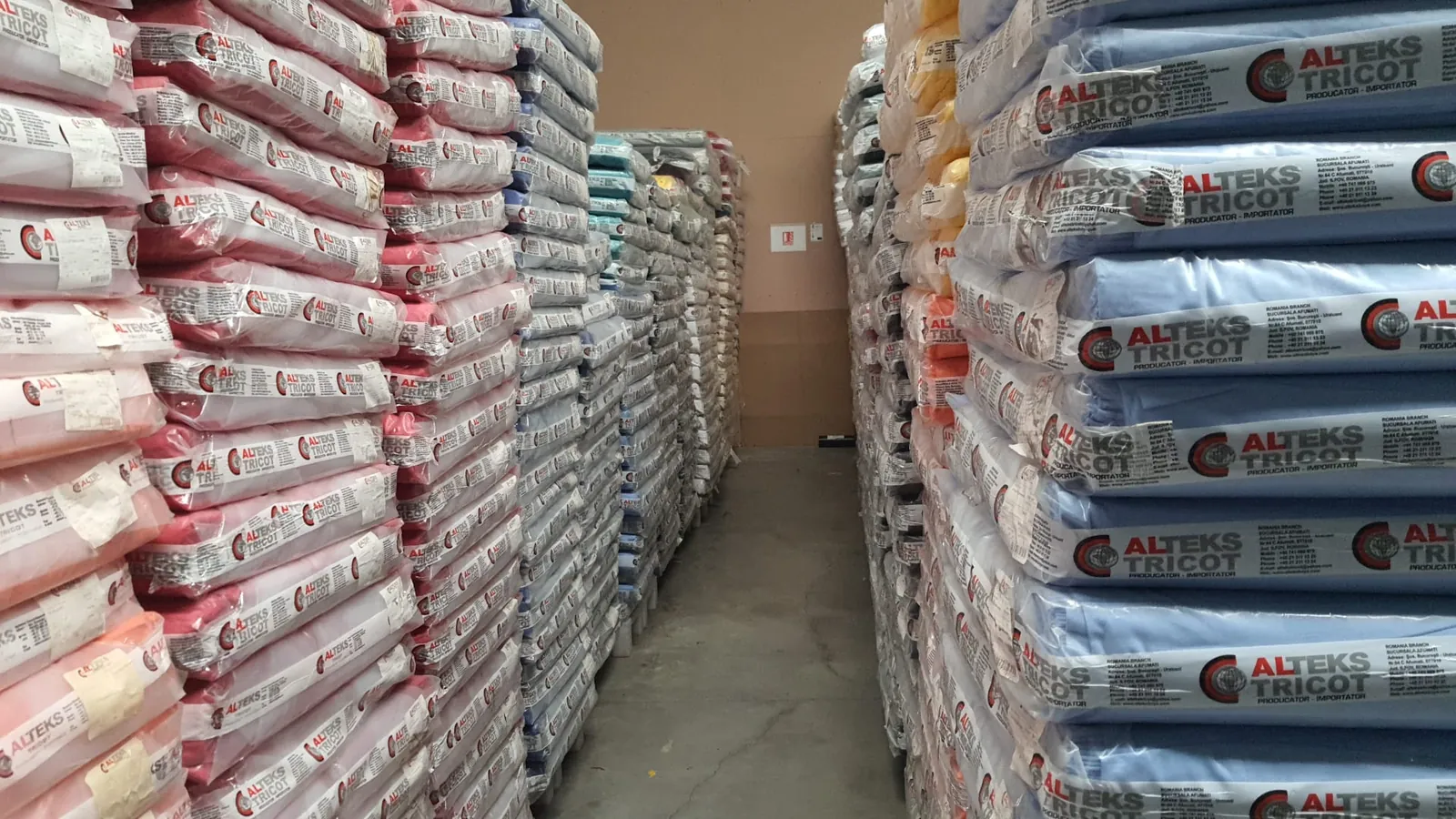
From stock, no minimum order.
Take exactly what you need from our Afumați stock — one roll or a pallet. Ask for the current stock list and get it on WhatsApp or by email.
 0 kg minimum