
Printing & decoration
DTF, DTG, screen printing, sublimation, roll printing, embroidery.
52 articles Printing & decoration
Can you use DTF printing on cotton single jersey?
Yes, cotton single jersey is one of the best bases for DTF.
 Printing & decoration
Does DTF work on cotton-polyester blend jersey?
Yes, DTF works well on cotton-polyester blends such as 60/40 or 50/50, and it is often the safer choice compared with other direct methods.
 Printing & decoration
Can DTF be used on 100% polyester without colour change?
It can, but temperature needs care.
 Printing & decoration
Why does DTG printing need pre-treatment?
Pre-treatment is a liquid applied to the print area that stops ink from spreading into the fibres and helps white pigment ink cover properly.
 Printing & decoration
What is the best fabric for DTG printing?
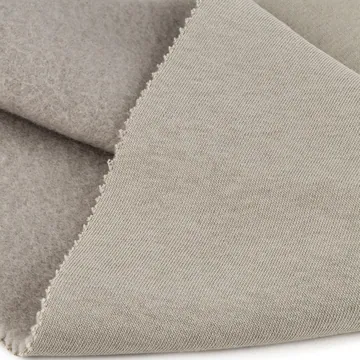
The best base is 100% cotton with a smooth surface and short fibres, preferably combed or ring-spun, in single jersey of about 150–220 gsm.
 Printing & decoration
What is the difference between plastisol and water-based screen printing ink?
Plastisol is a PVC-based ink in plasticiser that cures with heat at about 160 °C.
 Printing & decoration
What is discharge printing?
Discharge printing uses a water-based ink that breaks down the dye in the fabric within the printed area and, if it contains pigment, replaces it with a new colour.
 Printing & decoration
What is puff printing and which knit suits it?
Puff is a screen-printing ink with an expanding agent that swells under heat and creates a soft raised relief, like fine foam.
 Printing & decoration
What is high-density printing and how does it differ from puff?
High-density is a thick ink applied in layers that gives a hard raised relief with sharp edges and a smooth surface, like a rubber stamp.
 Printing & decoration
Is sublimation only possible on light-coloured polyester?
Yes.
 Printing & decoration
What is dye migration on polyester and how do we avoid it?
Dye migration is the movement of disperse dye from polyester fabric into the print layer on top, especially white or light colours, under heat or during storage.
 Printing & decoration
How does rotary pigment roll printing work on knitted fabric?
Rotary printing uses perforated nickel cylinders, one per colour, through which pigment paste with binder passes onto the continuously moving fabric.
 Printing & decoration
What is reactive roll printing and when is it worth it?
Reactive printing uses reactive dyes that bond chemically with the cellulose in cotton, followed by steaming and washing.
 Printing & decoration
What is digital roll printing and for which quantities is it used?
Digital roll printing works directly from a file, without screens or cylinders, using inkjet heads over advancing fabric.
 Printing & decoration
What does repeat size mean in an all-over print?
Repeat size is the dimension of one complete motif, across width and along length, after which the design starts again.
 Printing & decoration
What is the difference between printed fabric by the metre/kg and printing on cut pieces or garments?
Printed fabric is produced on the roll and then cut, so the design flows across the whole piece (all-over) and the cost per garment falls with volume.
 Printing & decoration
Can you embroider on single jersey without distortion?
You can, if you use the right stabiliser and moderate stitch density.
 Printing & decoration
How do you embroider on pique (polo) fabric?
Pique has a textured surface, so embroidery is done with a stabiliser, usually medium cut-away, plus a water-soluble topping film so the thread does not sink into…
 Printing & decoration
How do you embroider on fleece or hoodie fabric?
Fleece and hoodie fabric embroider well, because the material is thick and stable.
Printing & decorationWhat is the difference between cut-away and tear-away stabiliser?
Cut-away stays permanently behind the embroidery and is trimmed around it, while tear-away is torn off after stitching.
Printing & decorationWhat is HTV (heat transfer vinyl) and which knit is it applied to?
HTV is a vinyl film that is cut on a plotter and applied by heat pressing.
Printing & decorationWhat knit weight is best for screen printing?
For screen printing, single jersey of 160–220 gsm is a safe choice, and for heavyweight tees 220–280 gsm.
Printing & decorationWhat fabric weight suits DTF?
DTF works on almost any weight, from 120 gsm to thick hoodies, because the film is applied to the surface.
Printing & decorationWhy can a silicone finish affect print adhesion?
Silicone in a finish leaves a lubricating, water-repellent film on the fibre, so inks and adhesives no longer bond properly.
Printing & decorationHow do you test print durability through washing?
Run a wash test on a printed piece from the real lot: at least 5–10 washes at the temperature given on the care label, drying as the end user would.
Printing & decorationCan you print on melange knit fabric?
Yes, but the result differs.
Printing & decorationWhy does a print crack on knit fabric with elastane?
A print cracks when the ink or adhesive film is stiffer than the fabric and cannot follow the stretch.
Printing & decorationWhat file format and resolution are needed for DTF or DTG?
The safest option is a PNG with transparent background, at actual print size, 300 dpi, in RGB or the profile the printer requires.
Printing & decorationHow should colours be specified for printing: Pantone or CMYK?
For screen printing, specify Pantone colours, because each colour is mixed separately and printed through its own screen.
Printing & decorationWhich printing method for small runs: DTF or screen printing?
For small runs, below roughly 50–100 pieces, DTF is usually more practical: it needs no screens, accepts multicolour designs and gradients, and can be ordered per…
Printing & decorationWhich is better, DTF or DTG?
It depends on fabric and volume.
Printing & decorationShould knit fabric be washed before printing?
For most print methods washing is not required, but the fabric must be dimensionally stable and dry.
Printing & decorationWhy is a white underbase needed on dark colours?
An underbase is a white layer printed underneath, onto which the colours are applied.
Printing & decorationCan you print on rib knit?
You can, with caution, because rib is very stretchy and extends during wear.
Printing & decorationHow do you print on french terry or 3-thread fleece with a brushed back?
The face is smooth and prints normally, while the brushed back of 3-thread fleece is not printed.
Printing & decorationHow does the binder in pigment ink affect print hand feel?
In pigment printing, the binder is the adhesive that fixes colour particles to the fibre.
Printing & decorationHow is foil printing applied to knit fabric?
Foil is applied in two steps: a special adhesive is printed on the fabric, then the metallic foil is transferred by heat pressing and the excess is removed.
Printing & decorationWhat should you know about reflective and glitter prints on knit?
Reflective and glitter prints are usually special films or inks, applied by heat transfer or screen printing.
Printing & decorationWhat press settings are used for DTF: temperature, time, pressure?
Typical values are around 150–165 °C for 10–15 seconds at medium pressure, then waiting for cool-down or peeling the film according to the instructions.
Printing & decorationWhat do hot peel and cold peel mean in DTF?
Hot peel means the film is removed right after pressing, while the fabric is still hot; cold peel means waiting until it has cooled completely.
Printing & decorationWhat is rub fastness of a print?
Rub fastness shows how much print colour transfers onto another material under dry or wet rubbing.
Printing & decorationHow many washes does a DTF print last?
There is no fixed number: a well-executed DTF print on a compatible fabric can survive dozens of washes, but durability depends on the film, powder, pressing,…
Printing & decorationIs it better to print before or after garment washing?
It depends on the effect you want.
Printing & decorationHow do you print with water-based ink on a dark ground?
Water-based ink is transparent, so on a dark ground it gets lost.
Printing & decorationWhy is a print test (strike-off) important before bulk production?
A test shows how the print behaves on the real fabric: colour, adhesion, hand feel, migration and look after washing.
Printing & decorationWhat is the maximum size and recommended placement of a print on a t-shirt?
There is no single rule, but common practice is a front print of 28–35 cm wide on an adult size, starting 6–8 cm below the collar.
Printing & decorationWhy do shiny marks appear after heat pressing?
Shiny marks appear when heat and pressure flatten the fibres or slightly melt the surface, especially on dark shades, polyester and textured knits.
Printing & decorationHow do you print on thin knit without the ink showing through?
On thin knit, below about 140 gsm, ink can soak through and make the fabric stiff.
Printing & decorationWhat is flock printing and what does it suit?
Flock is a layer of short fibres bonded onto an adhesive, giving a velvety, suede-like surface.
Printing & decorationHow many colours can be screen printed and how are gradients done?
In screen printing each colour uses its own screen, so cost rises with the number of colours.
Printing & decorationEmbroidery or printing for uniforms and chest logos?
For simple logos on polos, hoodies or workwear, embroidery has a premium look, withstands repeated washing very well and suits pique and french terry.
Printing & decorationWhy does an all-over print look crooked on knit fabric (skew)?
Circular knit tends to twist, and the tube can lean so that wale lines are no longer perpendicular to the fabric length.
From stock, no minimum order.
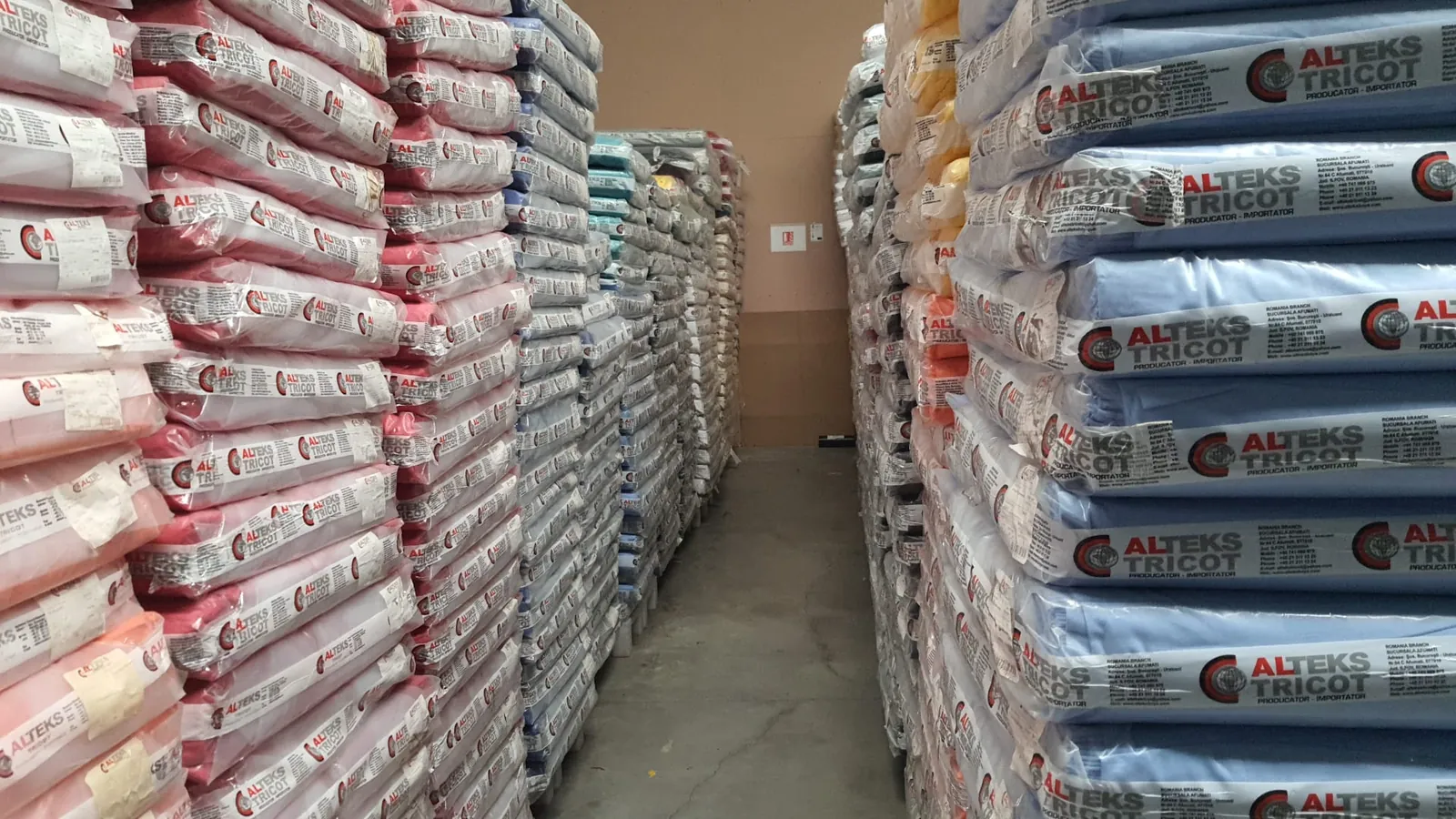
Take exactly what you need from our Afumați stock — one roll or a pallet. Ask for the current stock list and get it on WhatsApp or by email.
 0 kg minimum