
#Printing
Every The Knit Journal article about printing, for clothing brands, workshops and entrepreneurs.
 Starting a clothing brand
How to name a clothing brand: criteria and checks before you commit
A good name is easy to say, easy to spell, can be protected as a trademark and looks right embroidered on a chest. A great one does all four.
 Garment manufacturing
Lab dips, strike-offs and the golden sample: getting approvals
The costliest claims come from verbal approvals: 'the colour was different', 'the print was meant to be bigger'. Written approvals on physical samples prevent them.
 Garment manufacturing
How to manage print and embroidery subcontractors
When cut panels leave your workshop, control leaves with them. A clear process with your print or embroidery subcontractor protects your delivery date and quality.
 T-shirts
Which t-shirt fabric works best for DTF printing?
A DTF transfer bonds to the surface of the tee rather than soaking into the fibre, so the face, finish and stability of the jersey matter more than most people expect.
 T-shirts
Screen printing t-shirts: preparing the fabric and choosing ink
Screen printing is still the cheapest technique per piece on long runs, but only when the fabric, ink and curing are chosen together rather than one by one.
 T-shirts
DTG printing on t-shirts: which fabric and what pretreatment
A DTG printer puts ink straight into the fibre, so the result depends almost entirely on how much cotton the tee contains and how well it was pretreated.
 T-shirts
Heat transfer vinyl on t-shirts: settings for each fabric
Plotter-cut vinyl is the fastest route to a tee with a name, number or simple logo. How long it lasts depends on how well the vinyl, the press and the fabric are matched.
 T-shirts
How to print on grey melange and poly-cotton t-shirts
Melange looks simple, but it is a blend of fibres that react differently to ink and heat. Understand that and you can print on grey without surprises.
 T-shirts
DTF, screen, DTG or embroidery: which suits your order size?
There is no best print technique, only the right one for a particular order. Four questions will get you there in a few minutes.
 T-shirts
Event t-shirts: timelines, size splits and logistics
For an event, the t-shirt has one delivery date that never moves. Organisation matters more here than for any other order.
 T-shirts
Team and club t-shirts: names, numbers and the right fabric
Club orders come with dozens of different names, numbers and sizes. Without a clear system, one wrong letter ruins a shirt and a client relationship.
T-shirtsT-shirt print placement and print size for every size
The same 28 cm print looks perfect on a large and huge on an extra small. Correct placement is decided in the tech pack, not at the press.
 T-shirts
How to wash-test printed t-shirts before bulk production
Print faults are not visible on delivery; they appear after the third wash, at the customer's home. A test before the run costs a few tees and can save a whole order.
T-shirtsPuff, discharge and high-density prints on heavyweight tees
Speciality screen-print techniques turn a heavyweight tee into a collector's piece. They are demanding, though, and the wrong fabric cancels out the effect.
 Hoodies & sweatshirts
Puff print on hoodies: how to get a raised print that lasts
Puff print gives a streetwear hoodie texture and character, but it forgives very little. Artwork, ink, fabric and curing have to be planned together.
 Hoodies & sweatshirts
DTF transfers on hoodies: how to press them properly
DTF is fast and has no set-up cost, but a hoodie is a harder surface than a T-shirt. Preparation, the press and the fabric make the difference.
 Hoodies & sweatshirts
Screen printing hoodies: plastisol, water-based or discharge?
Your ink choice changes how the hoodie feels, how long the print lasts and which fabric colours you can print on. This practical comparison helps you decide.
 Hoodies & sweatshirts
Embroidery, DTF or screen print on hoodies: choose by quantity
Decoration is not chosen on taste alone. The number of pieces, the number of colours and the logo position completely change the cost per hoodie.
 Hoodies & sweatshirts
School and leavers' hoodies: how to run a class-by-class order
Leavers' hoodies and school crest hoodies are a predictable seasonal market. The winners are the suppliers with a clear process, not just a good price.
Hoodies & sweatshirtsHow to sell blank hoodies to print shops and merch companies
For a print shop, a blank hoodie is raw material. The supplier who wins is the one with constant stock, full size runs and a garment that prints without surprises.
 Polo shirts & uniforms
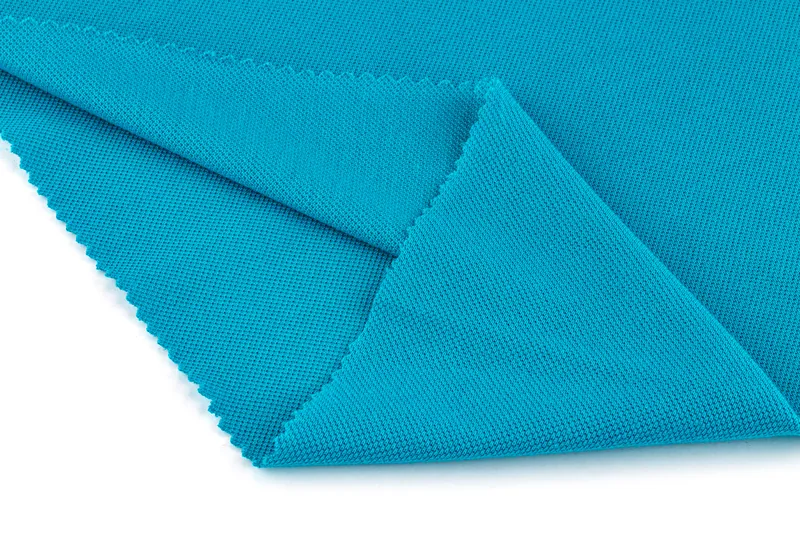
What is American piqué and when should you use it for polos?
The name turns up on plenty of fabric offers, yet few people can describe it precisely. A practical guide to its texture, uses and cutting pitfalls.
 Polo shirts & uniforms
How to make a sport polo shirt with polyester and elastane
A sport polo looks like a classic polo but behaves very differently at the cutting table, the machine and the heat press. These are the differences that matter.
 Polo shirts & uniforms
Printing on piqué polos: screen print, DTF or transfer?
The honeycomb that makes piqué attractive also makes it harder to print. With the right technique and preparation, results can be as clean as on jersey.
 Polo shirts & uniforms
How to make school PE t-shirts that survive weekly washing
The PE tee is the hardest-working item in any school uniform: sweat, running and an immediate wash. Production details decide whether it lasts until June.
Polo shirts & uniformsHow to build a uniform logo programme across all staff garments
When uniforms come from different workshops over different years, the logo ends up looking five different ways. A logo programme written once fixes that for good.
Kidswear & babywearPrints on kidswear: which method stays soft and safe
A print that looks great on an adult tee can feel stiff, oversized or unpleasant on a two-year-old. Choose the method by age and product, not by habit.
Kidswear & babywearPrinted tees for kindergartens, camps and kids' clubs
Summer camps, sports clubs and kindergartens order printed tees in small runs against fixed deadlines. It's a small but steady B2B market for workshops and kidswear brands.
 Loungewear, pyjamas & activewear
Printing on pyjama fabric: screen, DTF or all-over print?
On pyjamas, a print has to do more than look good in a photo. It must stay soft, let the fabric breathe and survive frequent, sometimes hot, washes.
Loungewear, pyjamas & activewearGym merch for fitness clubs: which products and fabrics
A tee with the gym logo can be extra income and a walking advert. Or it can sit in boxes in the storeroom. Planning makes the difference.
Loungewear, pyjamas & activewearPrinting on activewear: DTF, screen print and sublimation
A print that cracks at the first stretch, or a shiny mark from the press, ruins a good garment. In activewear, the print method is chosen together with the fabric.
 Costing, pricing & margins
How much does screen printing cost per T-shirt? Setup vs quantity
With screen printing you pay once for set-up and then for every pass. Quantity decides how much of the set-up lands on each T-shirt.
 Costing, pricing & margins
How to calculate the cost of a DTF print per garment
DTF has no per-colour set-up, which makes it ideal for small runs. The real cost lies in film area and minutes on the heat press.
 Costing, pricing & margins
Quantity price breaks for promotional T-shirts and merch
Merch buyers always ask what it costs if they take more. The answer should come from a deliberate price grid, not improvisation.
 Quality, compliance & sustainability
Colourfastness to washing and rubbing: testing dark knitted fabrics
A black tee that marks a pale sofa or turns grey after ten washes loses you the customer. Colourfastness testing predicts exactly those situations.
 Quality, compliance & sustainability
How to check print quality on T-shirts before they ship
A print can look perfect coming off the press and crack after the third wash. A few simple tests are the difference between a loyal customer and a return.
 Quality, compliance & sustainability
Are your prints and trims compliant? Inks, snaps and zips
The fabric can be flawless and the garment can still fail because of a snap or a print. Decoration and trims are the links brands check least often.
 Selling & marketing in Romania
How to sell branded clothing and merch to companies
Companies buy logo tees and hoodies all year, but rarely on impulse. Know the calendar and the people behind the decision and you win the orders.
 Selling & marketing in Romania
How to supply blank T-shirts to print shops
Print shops buy plain tees every week. A workshop that supplies them reliably, without surprises, becomes a partner that is hard to replace.